
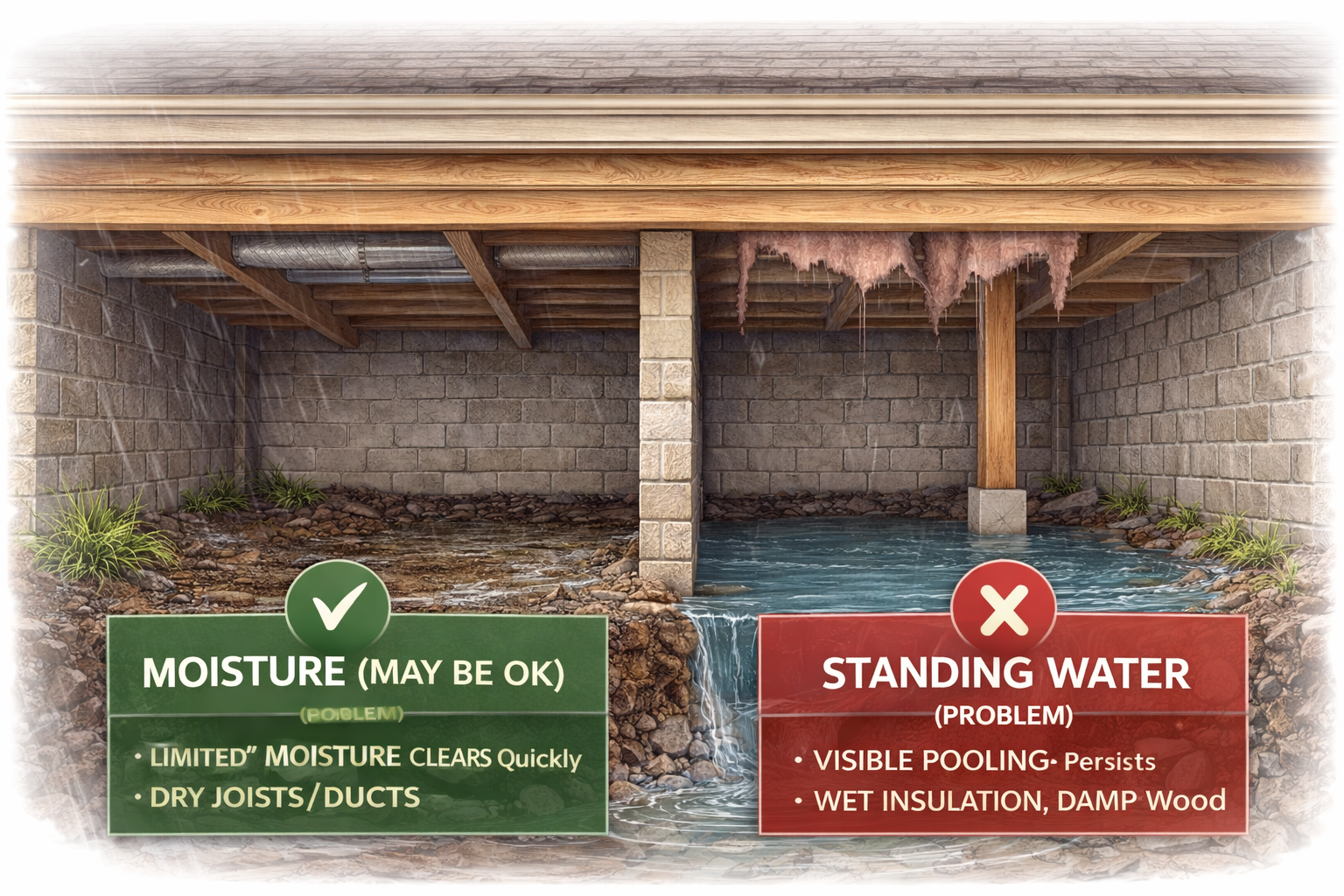
The Truth Most Homeowners Don’t Hear: “Normal” Depends on Behavior, Not Appearance
If you’ve opened a crawl space hatch and found moisture, the question feels immediate: is water in a crawl space normal?
Here’s the honest answer:
- A little moisture can be normal in certain conditions.
- Standing water is almost never normal.
- Anything that repeats, lingers, or worsens over time should be treated as a warning.
The mistake most homeowners make is deciding based on a single snapshot. Crawl spaces don’t tell the truth in one visit — they tell it in patterns.
This page gives you a clean decision framework: what is harmless, what is not, and what to observe so you don’t get trapped between false reassurance and unnecessary panic.
What “Normal” Actually Means in Crawl Space Terms
When inspectors or contractors say moisture is “normal,” they usually mean one of these controlled situations:
- Brief dampness after extreme weather that clears quickly
- Seasonal humidity causing light condensation (especially on ducts and pipes)
- Slightly damp soil with no pooling and no material wetness
But “normal” does not mean:
- standing water in low spots
- wet insulation
- wood that stays damp
- persistent musty odors
- humidity that stays elevated long after weather improves
A crawl space is part of your building envelope. If it stays wet, it eventually affects the structure and the air above.
The Crawl Space Water Decision Tree (Simple and Reliable)
Use this sequence. Don’t skip steps.
Step 1: Is it moisture or standing water?
- Moisture: damp soil, light condensation, slightly wet surfaces
- Standing water: puddles, pooling, visible depth, water collecting on vapor barrier
✅ Moisture can be normal.
❌ Standing water is rarely normal.
Step 2: How long does it last?
- Clears in 24–48 hours after a weather event → often lower risk
- Lingers several days → higher concern
- Remains week to week → active problem
Timing is the tell. Water that hangs around is not just reacting — it’s being fed by something.
Step 3: Does it repeat after ordinary conditions?
- Only after unusually heavy rain → may be temporary
- After routine rain → likely drainage weakness
- During dry weather → likely plumbing, condensate, or groundwater pressure
Step 4: Is it touching materials that matter?
This is the real red flag line:
- Dry joists + dry insulation → far safer
- Wet insulation, damp joists, staining, or musty wood → risk rising fast

Moisture vs Water: The Difference That Changes Everything
Homeowners often use “moisture” and “water” like they’re the same. They’re not.
Moisture (often manageable)
- Damp soil
- Condensation on ducts or pipes
- Slight dampness along foundation walls
- Humid air without visible puddles
Water (rarely normal)
- Pooling
- Puddles
- Water sitting on top of vapor barrier
- Drips forming consistently
- Soil saturation with visible wet sheen and seepage
Standing water creates a mini climate under your home — higher humidity, slower drying, and longer exposure.
When Moisture Can Be Harmless (Yes, Sometimes)
Moisture can be “normal” only if all three are true:
- It’s short-lived (clears within ~24–48 hours)
- It’s non-damaging (wood + insulation stay dry)
- It’s non-progressive (doesn’t get worse season by season)
Examples that can be low-risk:
- Slight damp soil after a rare storm
- Condensation during peak humidity that disappears when weather changes
- Brief wetness that never returns until the next extreme event
Even then, it’s not something to “ignore.” It’s something to track.
When Water in a Crawl Space Is Not Normal (The Hard Line)
These conditions are not normal in any practical sense:
- Standing water of any depth
- Moisture that remains for days repeatedly
- Water that returns after most rain events
- Humidity that stays consistently high (especially if the home smells musty)
- Any sign of rot, fungal growth, or persistent condensation
Some sources may say “a little water can be common,” but they still differentiate it from the conditions that rot wood, spike humidity, and impact air quality.
The “Hidden Normal” People Miss: Humidity Without Water
Sometimes the crawl space looks “dry,” but it’s still unhealthy.
A common tipping point used by crawl-space repair pros is relative humidity above ~60%, because conditions above that can support mold growth and moisture problems.
So you can have:
- no puddles
- but constant damp air
- condensation on ducts
- musty smell upstairs
That is not harmless. It’s just quieter.
Why Some Homes Get Moisture and Others Stay Dry
Two homes can sit on the same street and behave differently because of:
- Soil type (clay holds water; sandy soil drains faster)
- Grading (yard slopes toward the home vs away)
- Downspout discharge (too close to foundation vs extended out)
- Foundation permeability and seams
- Crawl space ventilation and temperature differences
Warm humid outside air hitting cooler surfaces can create condensation — a mechanism many crawl space companies describe when explaining why “humidity” becomes a crawl space problem.
A Practical “Normal vs Warning” Table
What You See | Behavior | Likely Meaning | Risk Level |
Slightly damp soil | Clears in 1–2 days | Weather-driven moisture | Low–Moderate |
Condensation on ducts/pipes | Seasonal; disappears when humidity drops | Humidity/temperature effect | Moderate |
Wet insulation | Doesn’t dry well | Environment staying wet | High |
Musty odor upstairs | Persistent | Crawl space air influencing house | High |
Standing water | Puddles remain | Drainage/groundwater issue | Very High |
Water during dry weather | Repeats without rain | Leak/condensate/groundwater | Very High |
The “Point of No Return” in Crawl Space Moisture Damage
Crawl space issues become expensive when moisture stops being an environmental annoyance and starts becoming material deterioration.
That point often arrives when you notice:
- sagging or soft floors
- fungal-looking growth on wood
- insulation falling or saturated
- rust/corrosion on metal components
- recurring smell that doesn’t go away
Even if the home looks fine upstairs, slow damage can develop underneath and appear later — which is why “it’s always been like that” isn’t a safe comfort.
How Crawl Space Moisture Affects the Living Space
A damp crawl space can push effects upward:
- Musty odors
- Elevated indoor humidity
- HVAC running harder
- Allergy irritation for some households
Multiple crawl space resources note that moisture can drive mold, mildew, and air quality issues if conditions persist.
The Resale/Inspection Angle Most People Learn Too Late
Even if you personally tolerate “a little damp,” buyers and inspectors typically don’t.
During inspection:
- standing water is flagged
- mold staining is flagged
- high humidity indicators (condensation, odor) raise concern
- repairs may be negotiated as credits or required fixes
If you plan to sell within a few years, the “normal vs warning” line should be stricter, because buyers price risk aggressively.
What to Observe Before You Decide Anything
You don’t need to guess. You need data.
After the next rain or humidity spike, record:
- When it appears (during rain vs hours after)
- Where it appears (same low spot vs random)
- How long it lasts (hours vs days)
- Whether materials are wet (insulation/wood)
- Whether the home changes (odor/humidity upstairs)
Patterns, not moments, decide what’s normal.
What This Page Does Not Decide
This page is boundary clarity — not system selection.
It does not decide:
- whether waterproofing is required
- whether drainage systems should be installed
- whether encapsulation is appropriate
Those choices depend on cause, severity, and persistence.
Key Reassurance Boundary
Water in a crawl space can be considered “normal” only when it is limited, short-lived, and non-damaging.
Standing water, recurring moisture, or anything that worsens over time is not normal — even if it only shows up after rain.
Final Perspective
Some crawl space moisture can happen. That part is real.
But “normal” is not a vibe — it’s a behavior profile:
- short duration
- no pooling
- no material impact
- no progression
If your crawl space fails any of those, treat it as a warning signal and gather observations before it becomes a repair you didn’t budget for.