
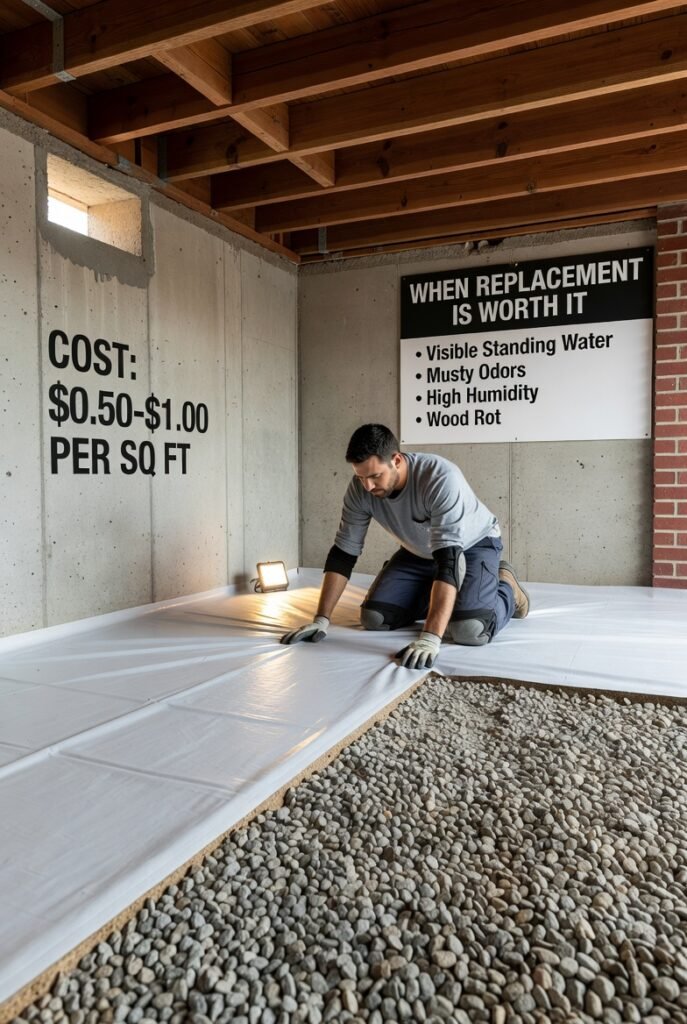
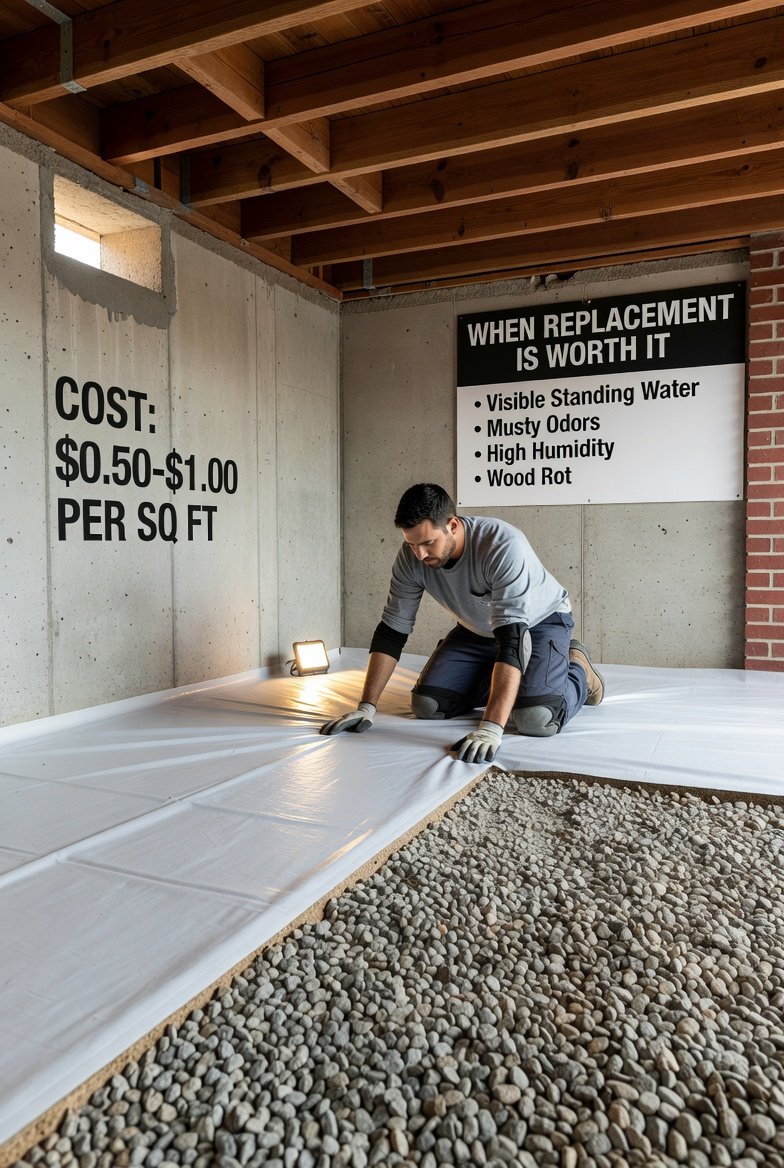
Cost to Replace Vapor Barrier in Crawl Space
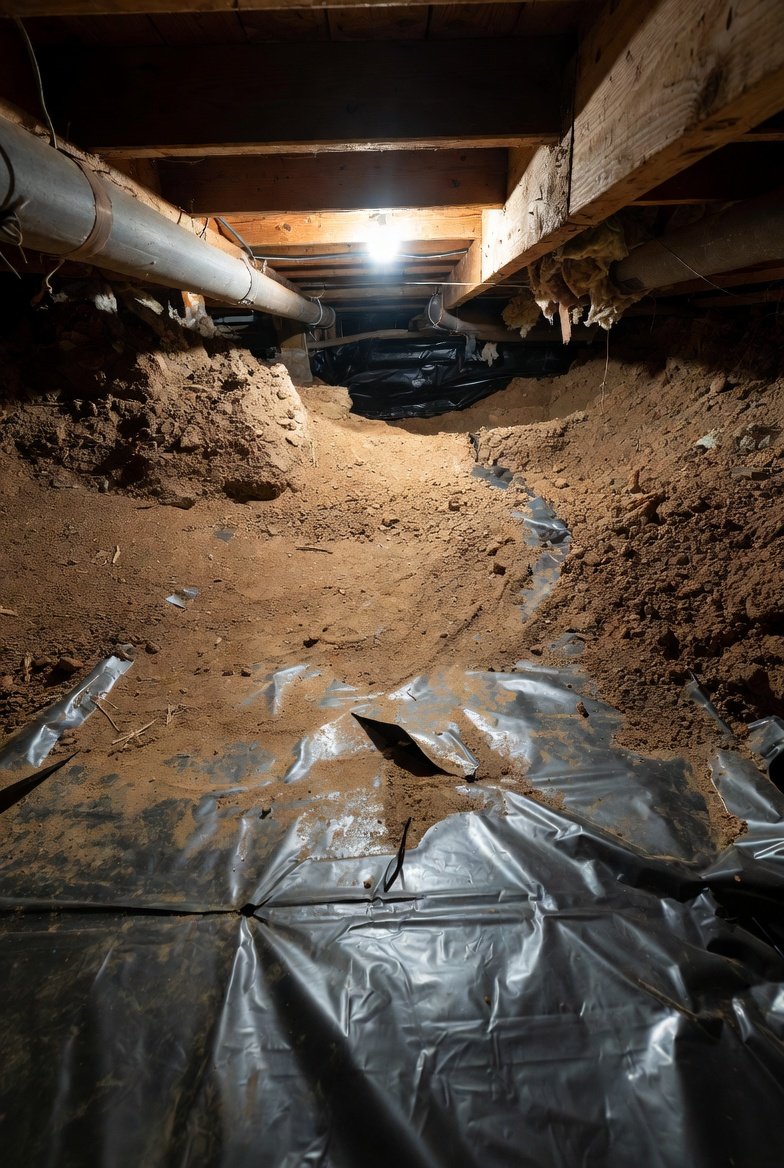
Replacing a crawl space vapor barrier sounds simple until you’re the one crawling in a tight space, peeling up filthy plastic, and finding out the “cheap” barrier failed because seams weren’t sealed — or because the crawl space was too humid in the first place.
This guide gives you real replacement pricing (not vague ranges), plus a clean decision tool:
- Patch vs partial replacement vs full replacement
- Price per square foot (with and without old liner removal)
- Labor cost drivers (clearance, debris, piers, wall run-up)
- How to stop the new barrier from failing again
If you need the component hub first (thickness + install standards), read:
https://crawlspacerepairguide.com/crawl-space-vapor-barrier/
Quick Answer: Typical Replacement Cost
Most homeowners pay about $0.50–$2.50 per sq ft to remove and replace a crawl space vapor barrier, depending on access, cleanup, and thickness. Industry “installed vapor barrier” ranges commonly land around $1,000–$3,000 for many homes, but replacement can be higher when removal is nasty or access is tight.
The Price Anchor Table: Replacement Cost Per Square Foot
Assumptions: ground cover replacement (not full encapsulation), seams taped, basic wall run-up unless noted.
Scope | What’s Included | Typical Cost (per sq ft) |
Patch repairs | Tape + patch sheets on tears/seams | $0.05–$0.25 |
Partial replacement | Replace damaged sections + re-tape seams | $0.50–$1.50 |
Full replacement (no major removal) | Remove light old plastic + install new barrier | $1.00–$2.00 |
Full replacement (heavy removal/cleanup) | Rodent waste, mud, saturated plastic, debris haul-out | $1.75–$2.50+ |
Reality: the plastic itself is rarely the expensive part — it’s labor + removal.
What Changes the Replacement Cost the Most
1) Crawl Space Height and Access
Low clearance slows everything down. More time in the crawl = higher labor.
2) Old Liner Condition
Replacement pricing jumps when the old barrier is:
- shredded into pieces
- buried in mud
- contaminated (rodents, moldy debris)
3) Thickness and Durability Tier
Replacing with heavier material costs more today, but usually fails less when techs have to access plumbing/HVAC.
If you want a thickness decision tool (6 vs 10 vs 20 mil), use:
https://crawlspacerepairguide.com/crawl-space-vapor-barrier/
4) Seams, Piers, and Wall Run-Up
The “cheap installs” skip the details:
- overlap + tape
- pier wrapping
- wall termination
Those details are exactly what stop repeat failure. (Code-style language often requires overlap and sealed seams plus wall extension in conditioned/unvented crawlspace approaches.)
Patch vs Partial vs Full Replacement Decision Guide
Use this like a homeowner’s decision tree.
Patch it if
- total tears are small and isolated
- seams are intact
- plastic is not brittle
- no widespread soil exposure
Rule of thumb: if <10% of the barrier is compromised, patching is usually rational.
Partially replace if
- one area is destroyed (near access hatch, plumber path, low spots)
- seams are separating in a specific zone
- old barrier is decent elsewhere
Rule of thumb: 10%–40% damage → partial replacement.
Fully replace if
- barrier is thin + shredded in multiple areas
- lots of soil exposure
- tape has failed across many seams
- you see repeated wetness + dirt contamination
Rule of thumb: >40% compromised, or the old plastic is contaminated → full replacement.
Important Reality Check: A New Barrier Won’t Fix Standing Water
A vapor barrier controls ground vapor diffusion. It does not solve bulk water.
If you have:
- puddles
- water stains on piers
- mud lines
- active seepage
Fix the water source first:
https://crawlspacerepairguide.com/water-in-crawl-space/
Replacing plastic over a wet crawl space is how people waste money twice.
Why Barriers “Fail Again” After Replacement
The #1 repeat-failure causes:
1) High Humidity and Condensation Misdiagnosed as “Ground Water”
If the plastic is wet on top, it can be condensation. The EPA advises keeping indoor humidity below 60% (ideally 30%–50%) and addressing condensation quickly.
If your crawl space stays humid, you may need dehumidification, not just new plastic:
https://crawlspacerepairguide.com/crawl-space-dehumidifier/
2) Seams Were Overlapped But Not Sealed
Overlaps without proper seam tape eventually separate, especially in humid regions.
3) No Mechanical Wall Termination
Adhesive-only wall attachment fails. Termination bars / fasteners hold.
4) Thin Plastic in High-Traffic Crawl Spaces
If HVAC/plumbing is down there, techs will walk on it. Thin plastic loses.
DIY Replacement Cost (When DIY Actually Makes Sense)
DIY replacement can be worth it when:
- crawl height is workable
- no contamination cleanup
- you’re replacing a simple ground cover
- no drainage problems
Typical DIY materials: plastic + seam tape + fasteners + patches. If you’re buying heavy-duty liner, some manufacturers/spec sheets describe intended crawl space usage and material formats (good for shopping specs).
DIY warning: If you suspect mold or persistent odor issues, don’t “plastic over the problem.” Read first:
https://crawlspacerepairguide.com/mold-in-crawl-space/
Professional Replacement: What You’re Paying For
A good pro replacement bid usually includes:
- old liner removal + disposal
- smoothing obvious puncture hazards (light grading / debris removal)
- full soil coverage
- seam overlap + taped seams
- pier wrapping (where needed)
- wall run-up + sealed termination (basic level)
If a quote is cheap because it skips seam sealing or wall termination, it often becomes a “replace again later” situation.
Replacement vs Upgrade: When Encapsulation Becomes the Smarter Spend
If you’re replacing the barrier because the crawl space is chronically humid, musty, or mold-prone, you may be chasing symptoms.
At that point, compare:
- Barrier only (component fix)
- Barrier + dehumidifier (humidity control)
- Full encapsulation (sealed system)
Start here:
https://crawlspacerepairguide.com/vented-vs-encapsulated-crawl-space/
And pricing here:
https://crawlspacerepairguide.com/crawl-space-encapsulation-cost/
Mini Cost Examples (So You Can Sanity-Check Quotes)
Example 1: “Clean” replacement
- 1,500 sq ft crawl
- light old plastic removal
- 10–12 mil replacement
- taped seams, basic wall run-up
Typical range: $1.00–$2.00/sq ft → $1,500–$3,000 (varies by access and labor market).
Example 2: “Dirty” replacement with cleanup
- shredded plastic + debris
- tougher removal + haul-out
- higher labor time
Typical range: $1.75–$2.50+/sq ft → $2,625–$3,750+ for 1,500 sq ft.
FAQs
How much does it cost to replace a vapor barrier in a crawl space?
Most replacements fall around $0.50–$2.50 per sq ft, depending on removal difficulty, crawl height, and thickness.
Is it cheaper to patch a vapor barrier than replace it?
Yes. If damage is small and localized, patching is usually far cheaper than full replacement.
Why is my new vapor barrier wet on top?
Often condensation or high humidity. The EPA recommends keeping humidity below 60% and addressing condensation quickly.
Do I need to tape vapor barrier seams?
For durability and continuity, yes. Many code-style requirements for conditioned/unvented crawl spaces specify overlapped joints that are sealed/taped.
Should I replace the vapor barrier before selling my home?
If an inspector flags torn plastic, exposed soil, or moisture symptoms, replacement can reduce buyer negotiation leverage.
Is replacement worth it if I have standing water?
Not until the water source is fixed. Start here: https://crawlspacerepairguide.com/water-in-crawl-space/
What thickness should I use when replacing?
Use a thickness based on traffic and service access. Guide: https://crawlspacerepairguide.com/crawl-space-vapor-barrier/
When should I upgrade to full encapsulation instead of replacing the barrier?
If humidity/mold/odor keeps returning, compare: https://crawlspacerepairguide.com/vented-vs-encapsulated-crawl-space/ and https://crawlspacerepairguide.com/crawl-space-encapsulation-cost/
1-Line Decision Matrix
Best overall: 10–12 mil replacement with taped seams + proper wall termination.
Best premium: 15–20 mil + underlayment where service traffic is common.
Best for tight budgets: patch or partial replacement if <10–20% is damaged.