
Crawl Space Encapsulation Pros and Cons (Neutral, Practical Guide)
If you’re researching crawl space encapsulation, you’re likely weighing a serious decision. It isn’t inexpensive, it isn’t always necessary, and it isn’t automatically a resale booster.
This guide presents a structured, neutral breakdown of crawl space encapsulation pros and cons so you can evaluate whether it fits your home’s condition, climate, and long-term plans.
For a full explanation of what encapsulation includes, see:
What Crawl Space Encapsulation Actually Is
Encapsulation is more than laying plastic over soil. A true system typically includes:
- Ground vapor barrier (often thicker material)
- Overlapped and taped seams
- Barrier extended up foundation walls
- Sealed vents and air gaps
- Air sealing at penetrations
- Often a humidity control strategy (such as a dehumidifier)
By contrast, a basic vapor barrier primarily blocks soil moisture without sealing the entire crawl space envelope.
If comparing the two approaches, review:
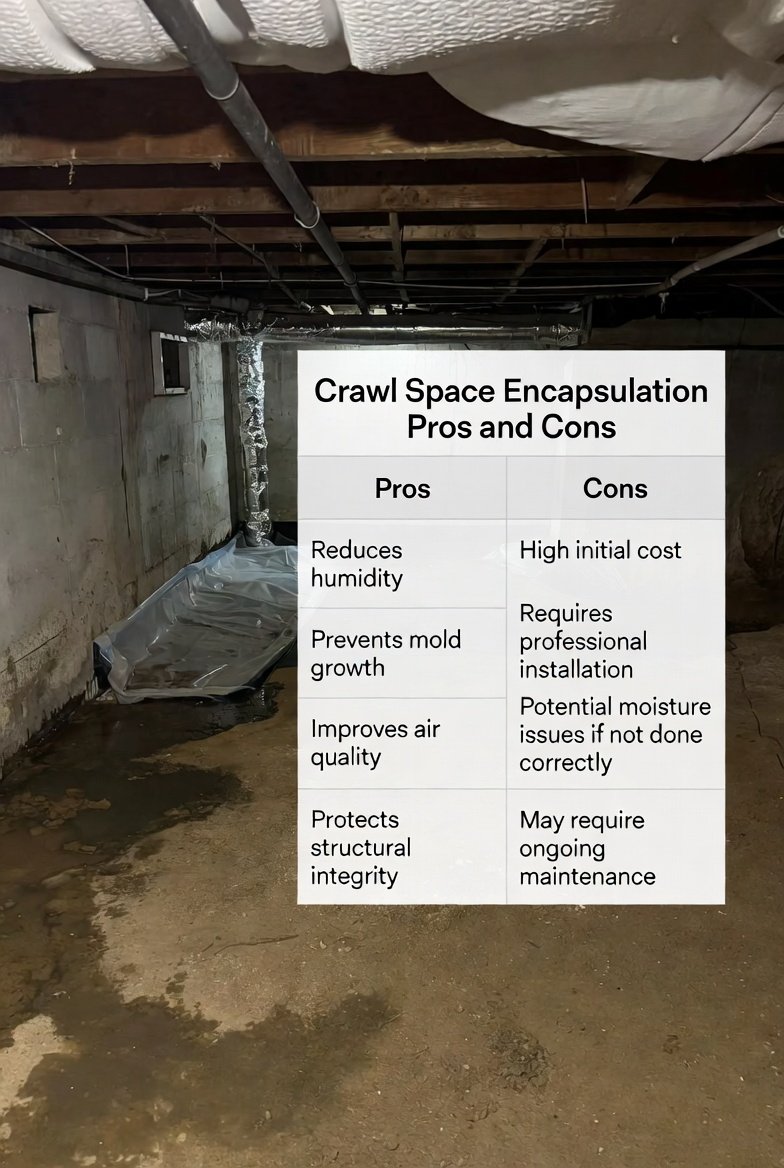
Pros of Crawl Space Encapsulation
1. Improved Moisture Stability
Encapsulation reduces moisture entering from soil and limits humid air exchange when vents and penetrations are sealed. This typically leads to:
- Lower relative humidity levels
- Reduced condensation risk
- Fewer musty odors migrating into living spaces
If you are currently diagnosing moisture issues, start here:
2. Reduced Mold-Friendly Conditions
Encapsulation lowers the moisture conditions that support mold growth. While it does not remove existing mold, it helps create a less favorable environment for future growth.
If mold contamination is already present, review:
crawl-space-mold-treatment-cost
3. Potential Air Quality Improvements
Because of the stack effect, air from the crawl space can migrate upward into the home. Stabilizing crawl space humidity may reduce musty odors and damp air infiltration.
Results vary depending on installation quality and overall home air movement.
4. Structural Protection Over Time
Persistent moisture contributes to wood rot, corrosion, and insulation degradation. Encapsulation reduces long-term exposure to moisture-related deterioration.
It is best viewed as a stabilization measure rather than a cosmetic upgrade.
5. Cleaner, More Manageable Crawl Space
Encapsulation creates a controlled environment that is easier to inspect, monitor, and maintain. Leaks, pest activity, and drainage issues are often easier to detect.
Cons of Crawl Space Encapsulation
1. Upfront Cost
Encapsulation can represent a significant investment depending on crawl space size and condition.
For pricing frameworks, see:
crawl-space-encapsulation-cost
For a structured estimator model, see:
crawl-space-encapsulation-cost-calculator
2. Installation Quality Is Critical
Improper installation can leave gaps, poorly sealed seams, or inadequate wall coverage. Without proper sealing and humidity management, moisture problems can persist.
Encapsulation performance depends heavily on correct detailing.
3. Humidity Management May Still Be Required
In humid climates, sealing alone may not maintain optimal humidity levels. A humidity control strategy may be necessary to keep relative humidity in a stable range.
Encapsulation without monitoring can lead to unexpected moisture retention.
4. Ongoing Maintenance
Encapsulation systems may require:
- Dehumidifier servicing (if installed)
- Sump pump inspection (if applicable)
- Periodic liner inspection for damage
Maintenance is typically manageable but should be anticipated.
5. It May Be Unnecessary in Some Homes
In homes with:
- Minimal moisture issues
- Stable, dry conditions
- No air quality complaints
A properly installed vapor barrier may provide sufficient benefit at a lower cost.
6. Drainage Issues Must Be Addressed First
If bulk water intrusion or seepage exists, sealing the crawl space before correcting drainage can trap moisture.
If drainage is part of your concern, review:
Crawl space repair cost
Decision Matrix
Scenario | Recommended Approach | Reasoning |
Persistent humidity and musty odors | Encapsulation (often with humidity control) | Improves moisture stability |
Standing water or seepage | Drainage first, then evaluate encapsulation | Prevents trapped moisture |
Mostly dry soil exposure | Vapor barrier + targeted sealing | May achieve similar benefit at lower cost |
Structural damage present | Repair first, then reassess | Structural integrity precedes sealing |
Selling soon | Stabilize moisture, avoid overbuilding | ROI varies by market |
When Encapsulation Makes Sense
- Long-term homeownership
- Recurring humidity concerns
- Moisture impacting structure or air quality
- Desire for environmental consistency under the home
When Encapsulation May Not Be the Best Choice
- Moisture levels are already stable
- Water intrusion has not been addressed
- Budget is better allocated to grading or drainage corrections
- The proposal lacks detailed scope clarity
Balanced Conclusion
Crawl space encapsulation can provide strong moisture stability and long-term structural protection when it aligns with the home’s actual conditions.
It can also be unnecessary or misapplied if moisture problems are minor, drainage issues remain unresolved, or installation quality is poor.
The correct decision depends on your specific moisture conditions, climate, budget, and ownership timeline.
BLOCK B
FAQs
Is crawl space encapsulation worth it?
It is often worthwhile in homes with persistent humidity or moisture-related risks. It may not be necessary in dry, stable crawl spaces.
Does encapsulation prevent mold completely?
No. It reduces moisture conditions that support mold but does not eliminate existing contamination.
Is a vapor barrier the same as encapsulation?
No. A vapor barrier blocks soil moisture. Encapsulation seals the crawl space as a complete system.
Does encapsulation increase home value?
It may improve buyer confidence in moisture-sensitive regions, but it does not guarantee a direct resale increase.
What is the biggest risk of encapsulation?
Improper installation or sealing without humidity management can limit effectiveness.