
Crawl Space Encapsulation Problems: Failure Signs, Root Causes & How to Fix Them
Crawl space encapsulation is designed to control moisture.
But homeowners sometimes notice:
- Persistent crawl space humidity issues
- Condensation forming on ductwork
- Mold under the vapor barrier
- Water trapped beneath the liner
- Musty odors that don’t go away
When that happens, the concern becomes:
Are these encapsulation failure signs — or was something missed?
In most cases, crawl space encapsulation problems stem from incomplete installation, ignored drainage, undersized humidity control, or misunderstanding how moisture behaves in enclosed spaces — not from the sealing concept itself.
If you need a refresher on how a complete system should work, review:
https://crawlspacerepairguide.com/crawl-space-encapsulation/
This guide focuses on diagnosing and correcting real-world problems.
Most Common Crawl Space Encapsulation Problems
The majority of issues fall into five categories:
- High humidity after encapsulation
- Condensation on ducts or framing
- Vapor barrier mold problems
- Water under the liner
- Dehumidifier sizing or performance issues
Each problem has a specific root cause — and a specific fix.
High Humidity Crawl Space Encapsulation Problems: Causes & Fixes
Encapsulation Failure Sign
Relative humidity remains above 60% after sealing.
According to EPA indoor air guidance, sustained humidity above 60% increases mold risk.
Why It Happens
Encapsulation blocks soil vapor and outside air, but it does not automatically remove existing moisture.
In humid climates especially, sealing without a properly sized dehumidifier can trap moisture inside.
This is one of the most common crawl space moisture issues after installation.
How to Fix Crawl Space Humidity Issues
- Install or upgrade a properly sized dehumidifier
- Seal remaining air leaks
- Monitor humidity levels regularly
Typical Cost: $800–$2,500
Time: 1 day
If bulk moisture is suspected, review:
https://crawlspacerepairguide.com/water-in-crawl-space/
Condensation After Encapsulation: Dew Point & Duct Issues
Why Does Condensation Form?
Condensation occurs when warm, moisture-laden air contacts surfaces below dew point temperature.
Encapsulation changes airflow and temperature dynamics. If ducts remain uninsulated or humidity stays elevated, condensation may form.
This is building science — not necessarily encapsulation failure.
Fix Strategy
- Insulate exposed ductwork
- Improve humidity control
- Evaluate dew point conditions
Cost Range: $300–$1,500
Time: 1 day
Vapor Barrier Failure & Mold Under the Liner
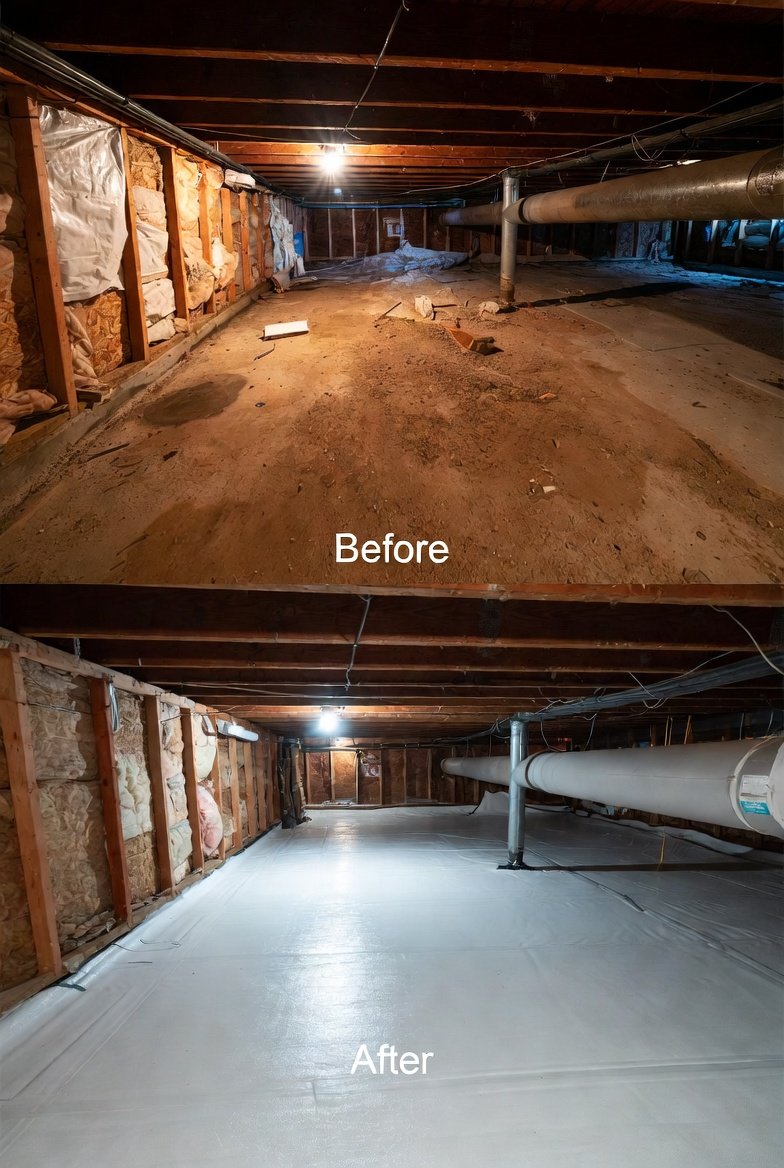
Mold under liner is often blamed on vapor barrier failure.
In reality, common causes include:
- Pre-existing mold not remediated
- Seams not fully taped
- Liner punctures
- Incomplete wall coverage
Encapsulation reduces future moisture exposure — it does not remove contamination.
For remediation cost context, see:
https://crawlspacerepairguide.com/crawl-space-mold-treatment-cost/
Typical Cost: $1,000–$3,500
Water Trapped Beneath the Vapor Barrier
Encapsulation is not a drainage solution.
If grading, groundwater, or runoff issues remain unresolved, bulk water can collect beneath the liner.
Correct drainage first:
https://crawlspacerepairguide.com/crawl-space-drainage-solutions/
Drainage Correction Cost: $1,500–$6,000
Time: 1–3 days
Encapsulation manages vapor — not groundwater.
Dehumidifier Undersizing & Encapsulation Troubleshooting
Encapsulation often depends on humidity control in humid or mixed climates.
Signs of undersizing include:
- Unit running constantly
- Humidity remaining elevated
- Excess condensation
Proper sizing depends on crawl space square footage and climate load.
For cost comparison of full systems, see:
https://crawlspacerepairguide.com/crawl-space-encapsulation-cost/
Encapsulation Troubleshooting Flow
If you notice encapsulation failure signs, evaluate in this order:
- Measure relative humidity
- Inspect drainage and grading
- Check liner seams and wall coverage
- Inspect duct insulation
- Verify dehumidifier capacity
Diagnosis should precede repair.
Encapsulation Problem Diagnostic Matrix
Symptom | Likely Cause | Fix Cost | Severity |
High humidity | Missing or undersized dehumidifier | $800–$2,500 | Moderate |
Condensation | Dew point imbalance | $300–$1,500 | Moderate |
Mold under liner | Pre-existing contamination | $1,000–$3,500 | Moderate |
Water under liner | Drainage failure | $1,500–$6,000 | High |
Persistent odor | Air leakage | $200–$1,000 | Low–Moderate |
For broader structural context, see:
https://crawlspacerepairguide.com/crawl-space-repair-cost/
Mini Case Example: High Humidity After Install
A 1,700 sq ft home in a humid region had encapsulation installed without a dehumidifier.
Humidity remained at 65–68%.
After installing a properly sized unit, levels stabilized at 45–50%.
The issue was incomplete scope — not system failure.
Climate-Specific Risk Considerations
Hot-Humid Regions
Always pair sealing with dehumidification.
Cold Climates
Monitor condensation risk during winter.
Mixed Climates
Seasonal monitoring is essential due to changing dew points.
Climate influences both risk and corrective strategy.
Common Misconceptions About Encapsulation Problems
- Encapsulation “traps moisture.”
It blocks vapor, but bulk water must be corrected first. - High humidity means the system failed.
Often it means humidity control was incomplete. - Mold under liner means sealing caused mold.
Pre-existing mold is usually responsible. - Removal is necessary if there’s a problem.
Most issues are correctable.
Key Takeaways
- Most crawl space encapsulation problems stem from incomplete systems.
- Drainage must be corrected before sealing.
- Humidity control is essential in many climates.
- Dew point physics explains condensation issues.
- Removal is rarely required.
Encapsulation is a system — not a shortcut.
FAQs
Why is my crawl space still humid after encapsulation?
Humidity typically remains high when dehumidification was not included or properly sized. In humid climates, sealing without active moisture removal can trap humid air.
What are encapsulation failure signs?
Common signs include humidity above 60%, condensation on ducts, mold under the liner, and water beneath the barrier.
Can vapor barrier failure cause mold?
Improper seam sealing or pre-existing mold can allow contamination to persist even after sealing.
How do I fix crawl space humidity issues?
Install a properly sized dehumidifier, improve air sealing, and address drainage concerns.
How much does it cost to fix encapsulation problems?
Minor fixes may cost a few hundred dollars, while drainage or mold remediation can range from $1,000 to $6,000 or more.
Is it safe to DIY vapor barrier repairs?
Minor seam repairs may be manageable, but drainage and mold issues often require professional evaluation.
Can encapsulation prevent energy loss?
When combined with air sealing and insulation, encapsulation can improve energy efficiency.
What happens if drainage is ignored?
Bulk water can accumulate beneath the liner, increasing structural and mold risk.
Is full removal necessary if problems occur?
Complete removal is uncommon; targeted corrections usually resolve issues.