
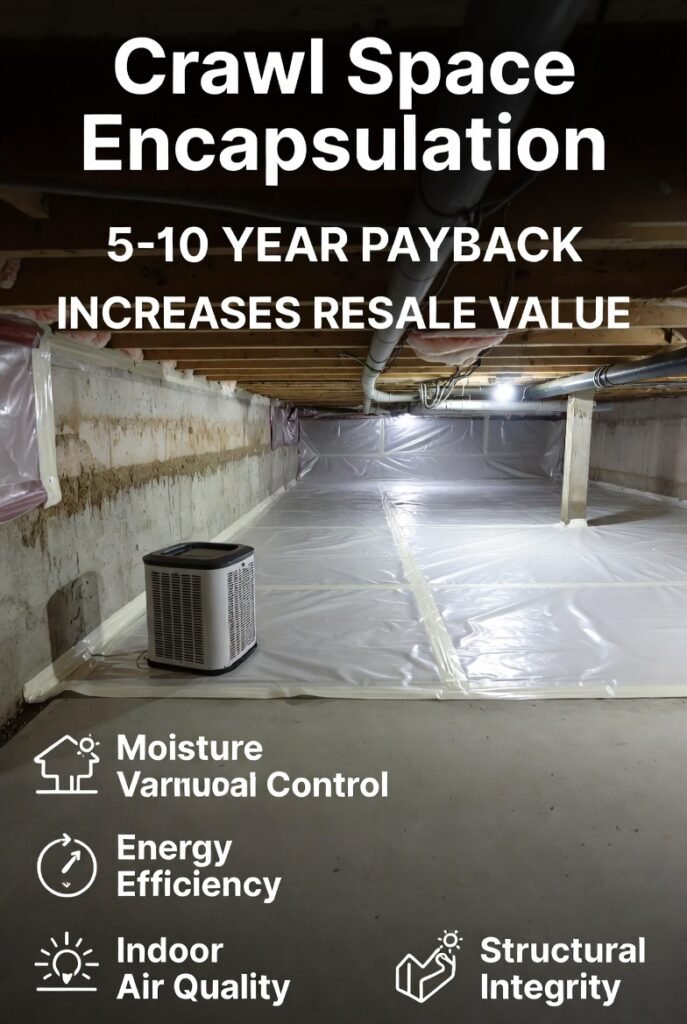
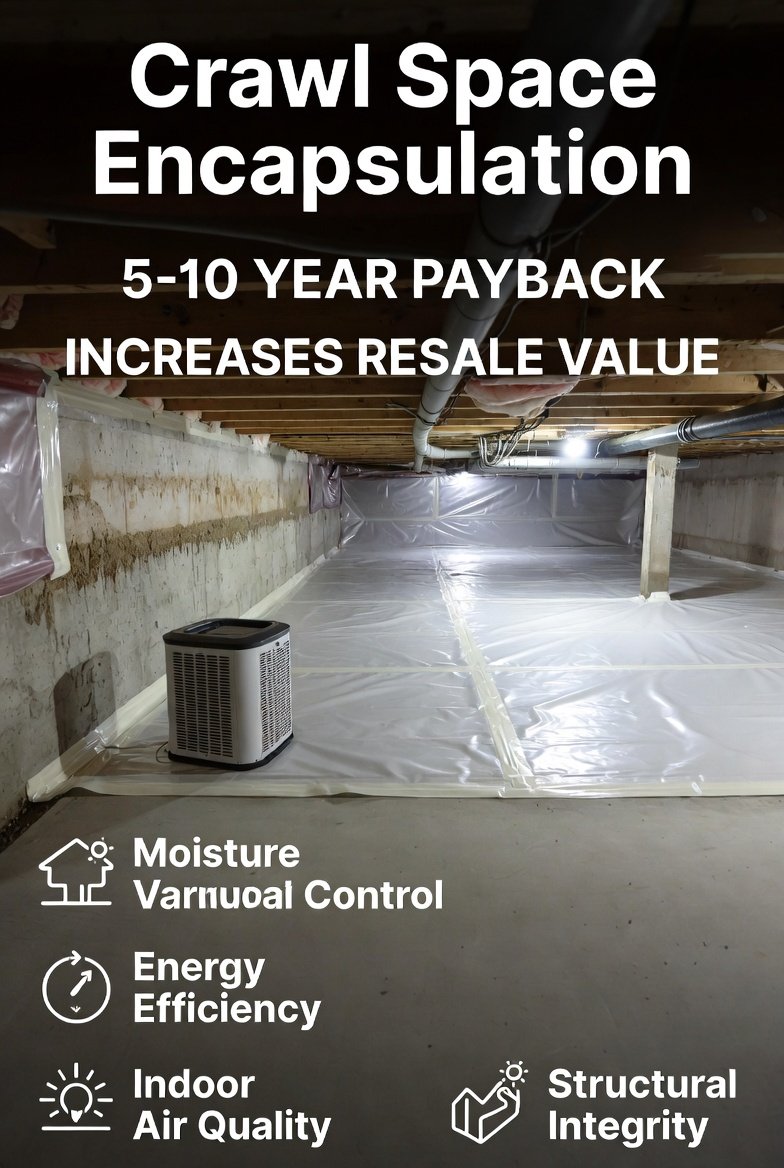
Crawl Space Encapsulation ROI: The Real 5–10 Year Financial Breakdown
Most homeowners don’t ask whether encapsulation works.
They ask whether it’s worth $8,000–$18,000.
The answer depends on math — not marketing.
This page models crawl space encapsulation ROI over 5 and 10 years using:
- Installation cost
- Energy savings
- Operating expenses
- Moisture risk reduction
- Resale / negotiation impact
- Climate variation
- Financing vs cash
No hype. No blanket promises.
If you need installation tiers first for modeling, compare:
https://crawlspacerepairguide.com/crawl-space-encapsulation-cost/
Step 1: Define ROI Properly (The Formula Most Pages Skip)
True ROI formula:
ROI (%) = (Total Benefit – Total Cost) ÷ Total Cost
For encapsulation, benefits include:
- Reduced HVAC load (energy savings)
- Lower mold probability (EPA recommends indoor humidity below 60% to reduce mold growth risk)
- Structural protection
- Resale negotiation advantage
Costs include:
- Installation
- Dehumidifier electricity
- Equipment replacement
- Maintenance
Without including operating costs, ROI math is incomplete.
Step 2: Installation Cost Baseline
Home Size | Typical Cost Range |
Small | $7,000–$10,000 |
Medium | $9,000–$14,000 |
Large | $12,000–$20,000 |
For modeling, we’ll use $12,000 as a baseline example.
Step 3: Energy Savings → How Much Will You Really Save?
Encapsulation reduces moisture load in the home. According to U.S. Department of Energy guidance on moisture control and HVAC efficiency, reducing indoor humidity lowers cooling demand in humid climates.
Estimated annual savings:
Climate | Annual Savings |
Humid Southeast | $250–$500 |
Midwest | $150–$350 |
Dry West | $50–$200 |
Example (Humid Climate):
$350 × 10 years = $3,500
But savings must be net of operating costs.
Step 4: Operating Costs → The Part Most ROI Pages Ignore
Dehumidifier Electricity
Average annual electricity cost:
$150–$300 (climate-dependent)
Replacement Unit
Most manufacturer warranties run 5 years.
Typical replacement at 5–7 years: $1,200–$2,000.
Filters & Minor Maintenance
$50–$150 annually.
10-Year Operating Cost Model
Cost Type | 10-Year Estimate |
Electricity | ~$2,000 |
1 Replacement Unit | ~$1,500 |
Maintenance | ~$1,000 |
Total | ~$4,500 |
That’s the cost side of real ROI math.
Step 5: Risk Reduction → Moisture & Mold Avoidance
Mold remediation averages $5,000–$15,000 depending on severity. Subfloor and joist repairs can exceed $10,000.
Encapsulation does not eliminate risk entirely — but it significantly lowers probability in humid climates.
If your crawl space has prior water history, review:
https://crawlspacerepairguide.com/water-in-crawl-space/
ROI becomes stronger when baseline moisture risk is high.
Step 6: 10-Year Scenario Modeling
🟢 High-Humidity Region (Strong ROI Case)
Installation: $12,000
Energy savings (10 yrs): $3,500
Operating cost: -$4,500
Avoided remediation event: $8,000
Net benefit: Positive ROI
🟡 Moderate Climate (Break-Even Case)
Installation: $12,000
Energy savings: $2,500
Operating cost: -$4,500
Avoided minor remediation: $5,000
Net outcome: Near break-even
🔴 Dry Climate (Weak ROI Case)
Installation: $12,000
Energy savings: $1,200
Operating cost: -$4,500
Low remediation risk
Net outcome: Negative ROI
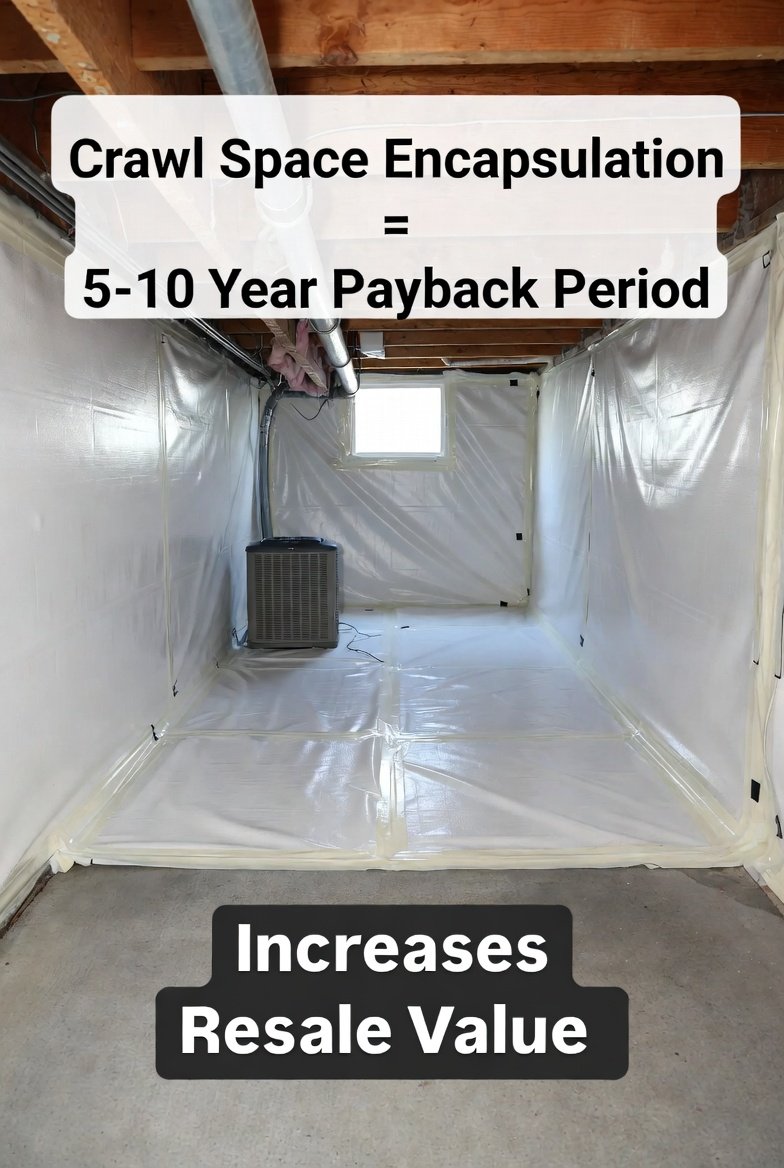
Encapsulation here is often resale-driven rather than savings-driven.
Resale Impact → Negotiation Leverage, Not Appraisal Magic
Encapsulation rarely adds a direct appraisal line item.
However, during transactions it can:
- Prevent buyer repair credits
- Remove inspection objections
- Increase buyer confidence
Example:
$400,000 home
Buyer requests $7,000 repair credit due to moisture concerns
Encapsulation may eliminate that negotiation entirely.
That’s indirect ROI.
If comparing sealed vs vented performance for resale positioning:
https://crawlspacerepairguide.com/vented-vs-encapsulated-crawl-space/
Payback Timeline Estimate
In humid regions:
Net annual benefit after operating cost ≈ $300–$500
Estimated payback: 7–12 years.
In dry regions:
Payback may exceed 15 years — or not occur.
When ROI Is Strong → Humid Homes & Moisture History
- High humidity climate
- Existing mold risk
- Prior water intrusion
- Planning resale within 5–10 years
- Higher home value markets
When ROI Is Weak → Dry Climate Caveats
- Low humidity region
- No crawl space moisture history
- HVAC not significantly impacted
- Short-term ownership horizon
In these cases, targeted moisture management may outperform full encapsulation.
Sensitivity Analysis: What Moves ROI Most?
Variable | Impact Level |
Climate humidity | Very High |
Moisture history | Very High |
Home value | High |
Installation quality | High |
Electricity rates | Moderate |
Climate and moisture history dominate ROI outcomes.
Frequently Asked Questions
Does crawl space encapsulation increase home resale value?
Not directly on appraisal sheets, but it often reduces buyer negotiation leverage related to moisture issues.
Can encapsulation prevent mold completely?
No. It reduces moisture exposure significantly but requires proper humidity control and maintenance.
Is encapsulation better than repeated remediation?
Yes. Addressing root moisture causes is generally more cost-effective long-term.
Does encapsulation extend HVAC lifespan?
Lower humidity reduces HVAC strain, potentially improving long-term efficiency.
How much does it cost to run a crawl space dehumidifier?
Approximately $150–$300 per year depending on runtime and electricity rates.
Is encapsulation worth it in dry climates?
Often less financially compelling unless resale positioning is important.
Final Financial Perspective
Encapsulation is not a guaranteed profit investment.
It is:
- Risk mitigation
- Energy stabilization
- Structural protection
- Transaction leverage
In humid climates with moisture history, ROI can exceed cost over 10 years.
In dry climates with no issues, ROI may be limited.
The smartest approach is climate-aware, math-driven, and honest about operating costs.