
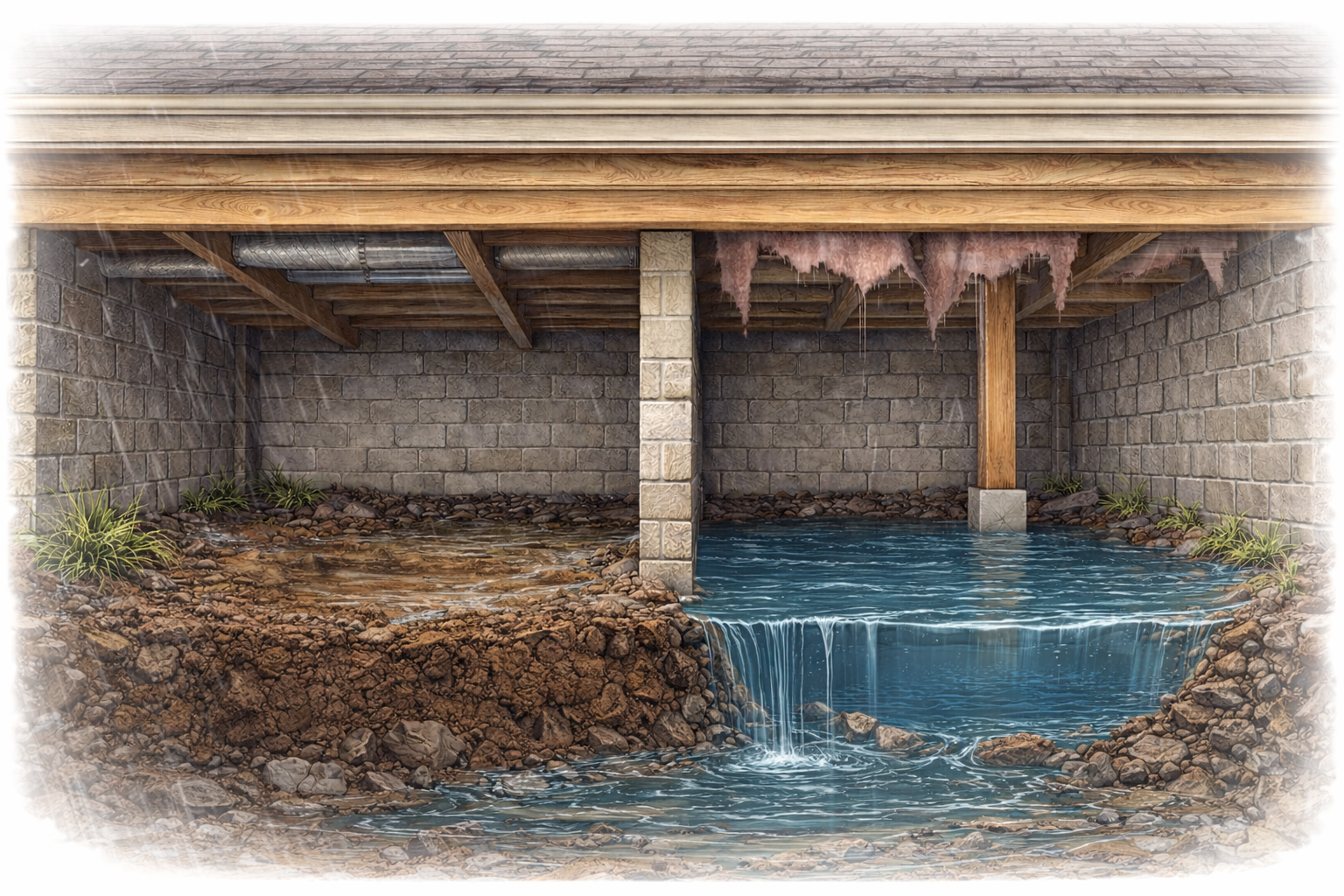
Crawl Space Flooding Is Not Just Water — It Is Structural Exposure
Most crawl space problems develop quietly.
Flooding does not.
When a crawl space floods, the home has crossed from environmental moisture into active structural exposure. Water is no longer interacting with the space — it is occupying it.
That distinction matters because the moment water accumulates faster than it can drain, risk stops being theoretical.
It becomes operational.
This guide explains exactly what crawl space flooding means, how severity escalates, and what typically unfolds after water enters — so homeowners understand the trajectory, not just the event.
What Truly Qualifies as Crawl Space Flooding
Homeowners often describe any water as “flooding,” but true crawl space flooding has defining characteristics.
Flooding occurs when:
- standing water forms across portions of the floor
- water persists rather than recedes
- spread increases instead of shrinking
- materials become submerged or saturated
This is categorically different from:
- damp soil
- condensation
- temporary storm moisture
Once measurable water depth exists, the crawl space is no longer buffering environmental conditions — it has been overtaken by them.
Why Flooding Signals a System Failure
Crawl spaces are designed to tolerate some environmental moisture fluctuation. Flooding indicates those protective dynamics have been exceeded.
Typically, at least one of the following has occurred:
- drainage capacity has been overwhelmed
- groundwater pressure has surpassed resistance
- runoff is being directed toward the structure
- an internal plumbing event has released water
Flooding rarely represents a cosmetic issue. It almost always points to a breakdown in water management beneath the home.
The Damage Timeline Most Homeowners Never See
One of the most dangerous myths is that serious damage takes months.
Flooding compresses that timeline dramatically.
First 24 Hours
- insulation begins absorbing water
- humidity spikes rapidly
- evaporation increases structural moisture load
24–72 Hours
- wood moisture levels rise
- metal components begin early corrosion
- microbial conditions become favorable
Several Days
- insulation loses thermal effectiveness
- persistent dampness settles into framing
- odors often begin forming
Repeated or Long-Duration Flooding
- wood can weaken
- fasteners degrade
- structural repair scope increases
Damage is not always immediate — but the conditions that allow it establish quickly.
Flooding accelerates the house’s moisture clock.
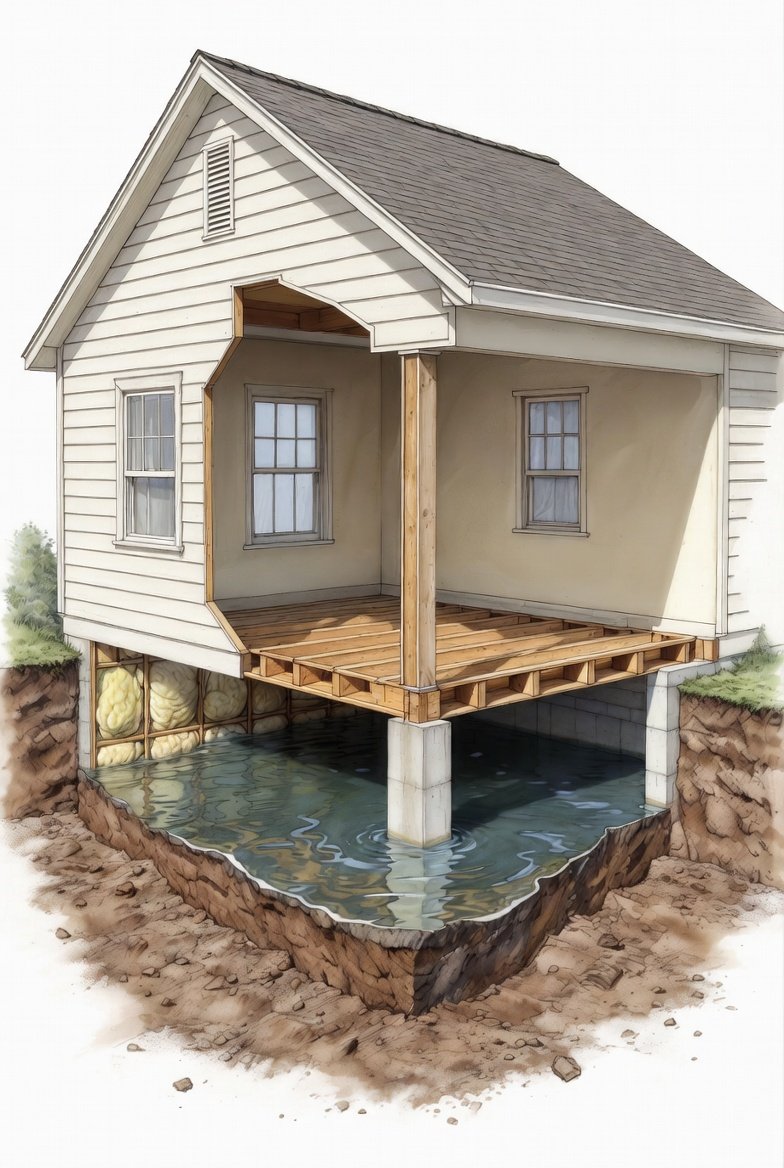
Depth Determines Severity Faster Than Most People Realize
Floodwater depth directly multiplies exposure.
Shallow Flooding
Typically affects:
- insulation
- vapor barriers
- air conditions
Moderate Flooding
Often reaches:
- framing components
- fasteners
- mechanical lines
Deep Flooding
May contact:
- joists
- subflooring
- utilities
Every additional inch expands the number of materials exposed.
This is why flood events escalate repair complexity rapidly.
Crawl Space Flooding vs Water After Heavy Rain
Not every storm-related water event qualifies as flooding.
Key distinction:
Rain reaction:
Water in crawl space appears but drains as soil releases saturation.
Flood condition:
Water remains — sometimes even after weather clears.
Persistence is the dividing line.
If water is still present days later, the water in crawl space is no longer shedding moisture effectively.
Why Flooding Often Feels Sudden — But Rarely Is
During emergency inspections, homeowners frequently describe flooding as coming “out of nowhere.”
In reality, earlier signals were often present:
- occasional pooling
- slow drainage
- recurring moisture
- seasonal dampness
Flooding is usually the final escalation of a long-building pressure pattern rather than a random event.
The crawl space had been warning the structure — quietly.
The Structural Risk Threshold (Point of No Return)
Is water in crawl pace normal?
Flooding becomes significantly more serious once water reaches structural materials.
Watch for:
- submerged insulation
- damp or darkened wood
- visible water lines
- shifting debris
At this stage, the concern is no longer simply water removal.
It becomes material preservation.
The longer structural elements remain wet, the higher the probability that repair scope expands.
Why Repeated Flooding Is Far More Dangerous Than a Single Event
A single flood is disruptive.
Repeated floods are destabilizing.
With recurrence:
- materials never fully dry
- moisture compounds
- structural stress accumulates
Homes that flood multiple times often face escalating repair requirements because each event builds on the last.
Moisture memory exists in building materials.
How Crawl Space Flooding Impacts the Living Space Above
A flooded crawl space rarely stays isolated.
Air moves upward through the structure, carrying moisture with it.
Common downstream effects include:
- sharp indoor humidity increases
- persistent odors
- heavier HVAC workload
- comfort instability
The crawl space is part of the home’s environmental system — not a detached void.
The Financial Reality Most People Discover Late
Standing water in crawl space cost to fix
Flooding is not just a water event.
It is often a cost multiplier.
The earlier flooding is recognized as serious, the more likely homeowners are to limit cascading repair scope.
Delay tends to expand the number of affected materials rather than contain them.
Key Emergency Boundary
Crawl space flooding is an emergency once standing water persists, spreads, or contacts materials.
At that moment, risk shifts from potential to active — even if visible structural damage has not yet appeared.
Recognition speed matters.
What This Page Intentionally Does Not Decide
This page establishes severity — not solutions.
It does not determine:
- which repair method is appropriate
- whether waterproofing is required
- whether encapsulation is necessary
Those decisions depend on cause, extent, and site dynamics.
What to Document Immediately After a Flood Event
Clear observations reduce uncertainty later.
Record:
- approximate water depth
- coverage area
- how long water remains
- whether this has happened before
These variables define both urgency and scope.
Final Perspective
Crawl space flooding is not elevated moisture.
It is a structural exposure event.
Understanding how quickly conditions can escalate allows homeowners to respond with awareness rather than hesitation.
Flooding is not simply inconvenient — it is informative. It signals that the water-management balance beneath the home has been exceeded.
This page exists to clarify that boundary so decisions
❓ FAQs
What qualifies as crawl space flooding?
Flooding involves standing water that persists, spreads, or submerges materials rather than brief surface moisture.
How serious is a flooded crawl space?
Flooding represents active structural exposure because water is occupying the space rather than draining.
Can crawl space flooding cause damage quickly?
Yes. Elevated humidity, insulation saturation, and material exposure can begin shortly after flooding occurs.
Does crawl space flooding affect indoor conditions?
Yes. Moisture and odors can migrate upward, influencing the living environment.