
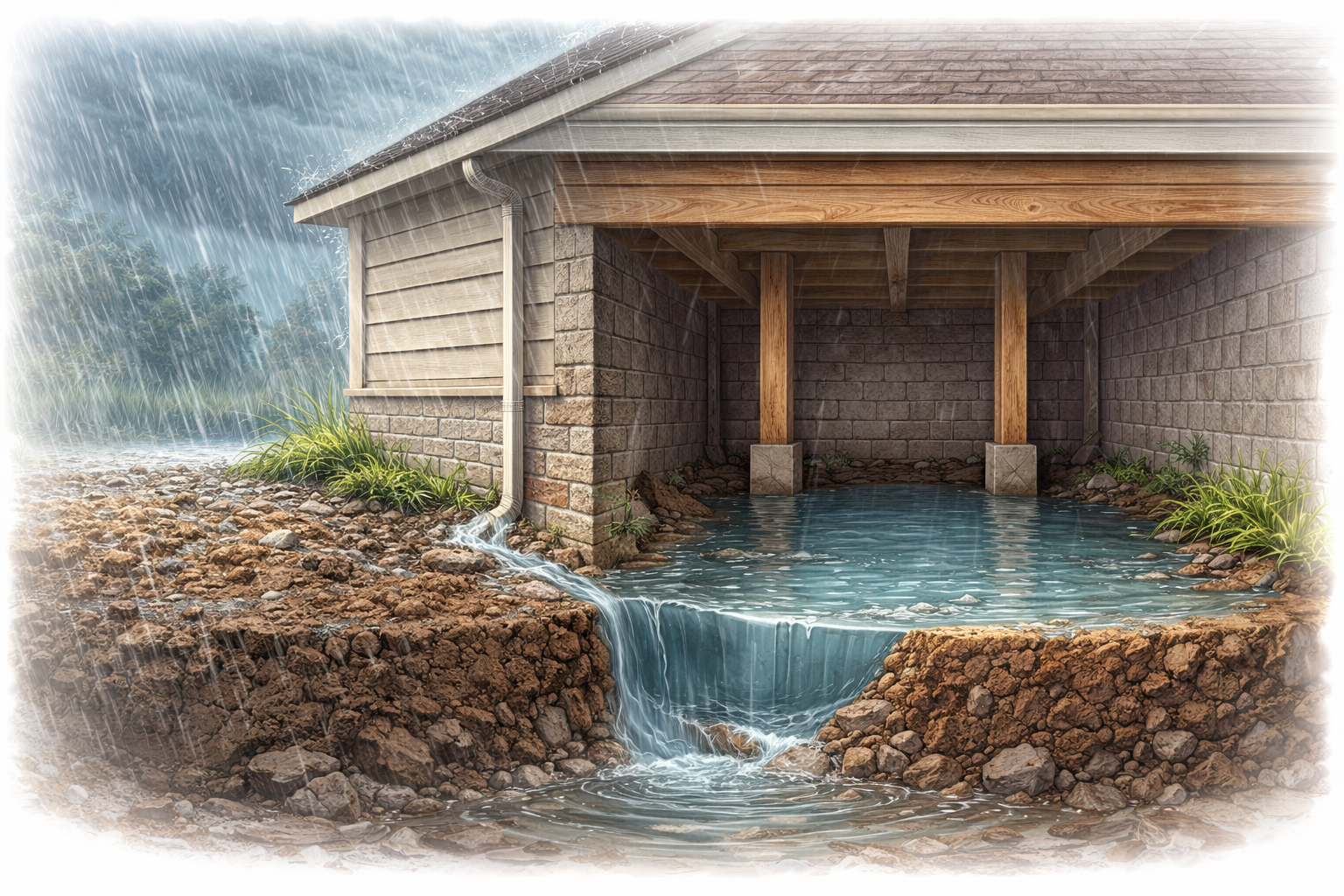
After a Heavy Rain, Crawl Spaces Often Reveal What the Soil Is Doing
Few home discoveries create faster uncertainty than finding water beneath the floor after a storm. Homeowners immediately wonder whether they are seeing a normal reaction to extreme weather — or the early signal of a developing moisture problem.
The challenge is that both scenarios can appear nearly identical at first glance.
A crawl space that briefly dampens after record rainfall may behave very differently from one that quietly accumulates groundwater year after year. Knowing which situation you are dealing with is less about the amount of water you see and more about how that water behaves.
This guide is designed to help you interpret what you’re seeing with calm precision so decisions are based on patterns rather than panic.
Why Heavy Rain Shows Up in Crawl Spaces First
Crawl spaces occupy one of the lowest structural positions in a home. When surrounding soil absorbs large volumes of rainwater, pressure builds underground. That pressure looks for relief — and foundations often become the pathway.
Several conditions make crawl spaces especially sensitive:
Standing water in crawl space cost to fix
- slow-draining soil such as clay
- grading that directs runoff toward the home
- minor foundation permeability
- limited airflow that delays drying
Because of this combination, crawl spaces frequently reveal water behavior before any interior symptoms appear.
In many homes, they act as an early detection zone.
The First Question to Answer: Is the Water Behaving Like Rain — or Groundwater?
Is water in crawl space normal
Rain-driven moisture usually follows predictable timing.
Groundwater behaves differently.
Understanding this distinction is one of the most valuable observations a homeowner can make.
Rain-Like Behavior
Often appears during or immediately after intense storms and fades relatively quickly once conditions dry.
Groundwater-Like Behavior
May appear hours later, linger longer, and return with increasing frequency.
When water stops behaving like weather and starts behaving like a pattern, attention is warranted.
A Simple Field Test You Can Use Without Equipment
Instead of guessing, treat the next storm as an observation opportunity.
Pay attention to four variables:
1. Speed of Appearance
Water entering during rainfall often points toward surface flow.
Water appearing later can suggest soil saturation.
2. Duration
Moisture that disappears within roughly a day is typically less concerning than water that lingers.
3. Depth
Light dampness signals something very different from pooling.
4. Repeatability
Patterns matter more than single events.
This framework alone resolves much of the uncertainty homeowners feel after storms.
When Rain-Related Crawl Space Water Is Often Temporary
Some homes simply experience environmental spillover during unusually heavy weather.
Moisture is more likely temporary when:
- the storm was unusually intense
- the crawl space dries within 24–48 hours
- structural materials remain dry
- no odor develops
In these cases, the crawl space may be reacting to weather extremes rather than signaling failure.
Still, even temporary moisture deserves awareness if storms become more frequent.
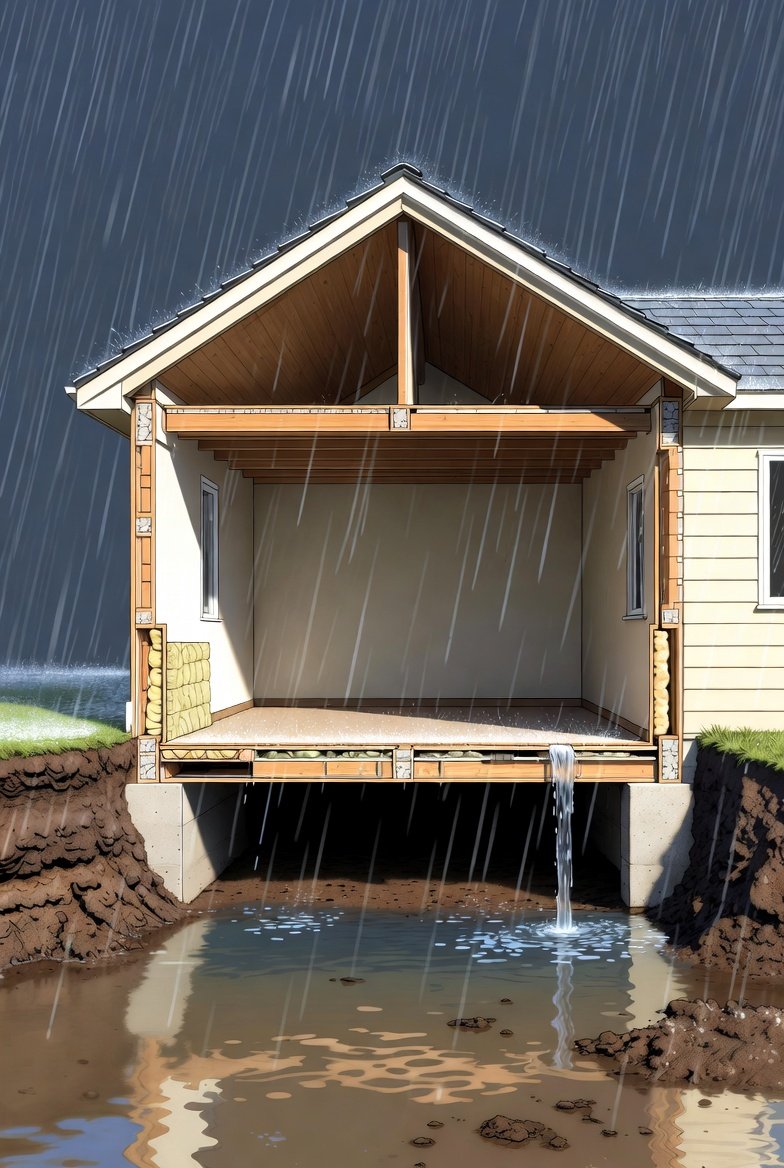
The Threshold Where Monitoring Should Shift Toward Concern
There is typically a moment when rain exposure stops looking incidental.
Watch for escalation signals:
- water appearing after most storms
- moisture lasting multiple days
- pooling in consistent locations
- humidity rising inside the home
These indicators suggest the crawl space is no longer shedding water efficiently.
Rain is no longer the cause — it is revealing a vulnerability.
Surface Dampness vs Standing Water — A Critical Distinction
Damp soil can occur without structural consequence.
Standing water is different. Crawl space flooding.
Pooling increases evaporation volume, which raises crawl space humidity and extends material exposure.
Even shallow standing water deserves attention because time amplifies its effect.
The risk is rarely dramatic — but it is cumulative.
Why One Home Drains and Another Holds Water
Two houses can endure the same storm yet experience completely different outcomes.
Key differentiators often include:
- slope direction
- drainage paths
- soil absorption
- low-point positioning
Homes that release water quickly usually have a reliable exit path. Those that trap moisture often lack one.
Understanding this removes much of the mystery homeowners feel.
Timing Often Reveals More Than Water Volume
Many people focus on how much water they see.
Professionals often focus on when it appears.
- Immediate water → surface pathways
- Delayed water → subsurface pressure
- Persistent water → drainage limitation
Tracking timing across multiple storms provides stronger insight than a single inspection ever could.
Seasonal Clues That Should Not Be Ignored
Some crawl spaces show patterns tied to climate cycles.
Common examples include:
- spring thaw combined with rain
- late-season storms after dry soil hardens
- extended rainy periods with minimal drying
Seasonal repetition often signals environmental pressure rather than coincidence.
Patterns are rarely random.
Inspector Perspective: The Pattern Almost Always Expands
During property evaluations, homeowners frequently describe crawl space water as something that “only happens after big storms.”
Yet historical observation often reveals a gradual shift — water appearing after smaller storms over time.
This usually indicates increasing soil saturation or drainage strain rather than isolated weather events.
The change tends to be subtle until it isn’t.
How Repeated Rain Exposure Quietly Raises Risk
Even when water clears between storms, repeated exposure cycles materials through moisture fluctuations.
Over time:
- wood absorbs and releases humidity
- insulation performance declines
- crawl space air remains damp longer
This progression is slow enough that many homes show no interior symptoms until the cycle has been repeating for years.
The Calm Decision Line: Monitor or Escalate?
A useful mental model is this:
👉 Single event → observe
👉 Developing pattern → investigate
Not every storm discovery demands immediate action. But recurring behavior deserves informed attention before it evolves into structural concern.
Calm observation is far more powerful than reactive worry.
What This Page Intentionally Does Not Decide
This guide focuses on interpretation — not correction.
It does not determine:
- whether waterproofing is necessary
- which drainage approach is appropriate
- whether encapsulation is warranted
Those decisions depend on confirmed cause and severity.
What to Observe After the Next Major Storm
Instead of reacting immediately, gather clarity:
- Did water appear faster than before?
- Did it linger longer?
- Is the location consistent?
- Is the trend improving or worsening?
Patterns answer questions that single inspections cannot.
Final Perspective
Heavy rain alone does not automatically signal crawl space failure. But water that begins forming predictable patterns rarely resolves without attention.
Understanding whether your crawl space is reacting to weather or revealing a deeper moisture behavior allows you to respond with strategy instead of urgency.
Clarity, not alarm, is the goal.
❓ FAQs
Is water in a crawl space after heavy rain normal?
Occasional moisture after unusually intense storms can occur, but repeated or lingering water is not considered normal.
How long should crawl space water last after a storm?
Temporary moisture often clears within about 24–48 hours. Longer persistence suggests drainage limitations.
Can heavy rain cause long-term crawl space damage?
Repeated exposure can gradually affect materials even if no immediate damage is visible.
How can I tell if rain-related crawl space water is serious?
Tracking appearance timing, duration, and recurrence helps distinguish temporary conditions from developing issues.