
Crawl Space Water Damage: What It Does to Your Home Over Time
Crawl space water damage almost never starts with a dramatic “flooded crawl space” moment. In most homes, it begins as a pattern: damp air that doesn’t clear, soil that stays wet longer than it should, or repeated small wetting cycles that leave materials slightly wetter each time.
That’s why crawl space damage feels confusing. The crawl space can look “mostly fine” on one visit—yet the underlying trend is still pushing the house toward deterioration.
This page is strictly consequences-only. It explains what crawl space water damage does, how it progresses, and how it affects structure, indoor air, and long-term stability—without prescribing systems or repairs.
What Crawl Space Water Damage Actually Means
“Water damage” in a crawl space isn’t defined by one bad day. It’s defined by duration + repetition.
A brief wet event that dries quickly may not create lasting damage. But when moisture exposure outlasts the drying window, materials begin to change.
A useful way to think about it:
- Moisture exposure = the event (humidity, seepage, pooling)
- Moisture retention = the problem (staying wet long enough to alter materials)
Moisture control and fast drying matter because mold risk and deterioration increase when wet materials don’t dry promptly; many building hygiene guides emphasize drying within roughly 24–48 hours as a key prevention boundary.
Why Crawl Spaces Are Built to Lose This Fight
Crawl spaces are naturally vulnerable because they combine:
- low air movement (slower evaporation)
- cooler surfaces (more condensation potential)
- direct contact with damp soil (continuous moisture source)
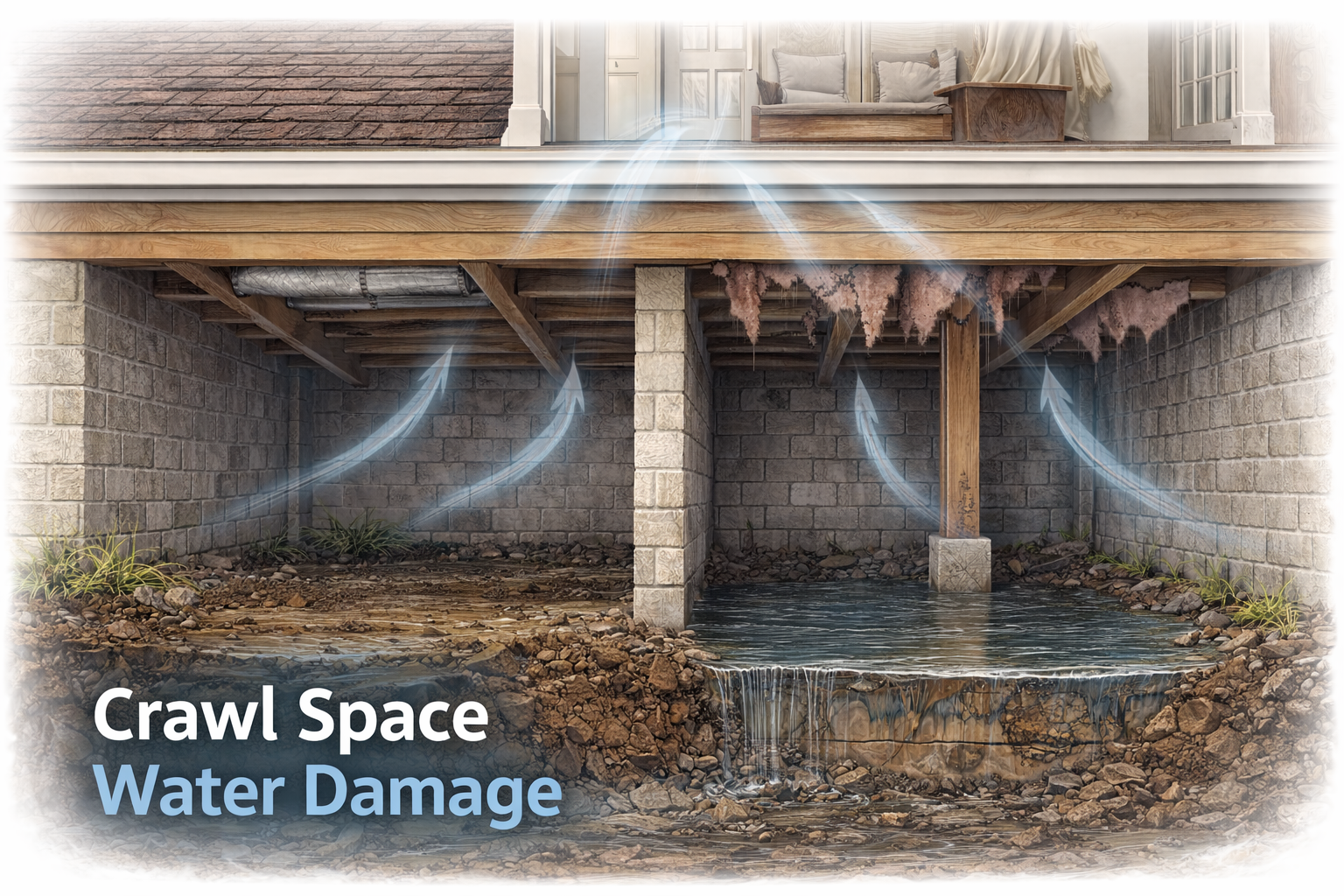
Even without visible puddles, a crawl space can operate like a humidity reservoir. When the crawl space stays damp, the home above inherits some of that condition through air pathways and pressure differences.
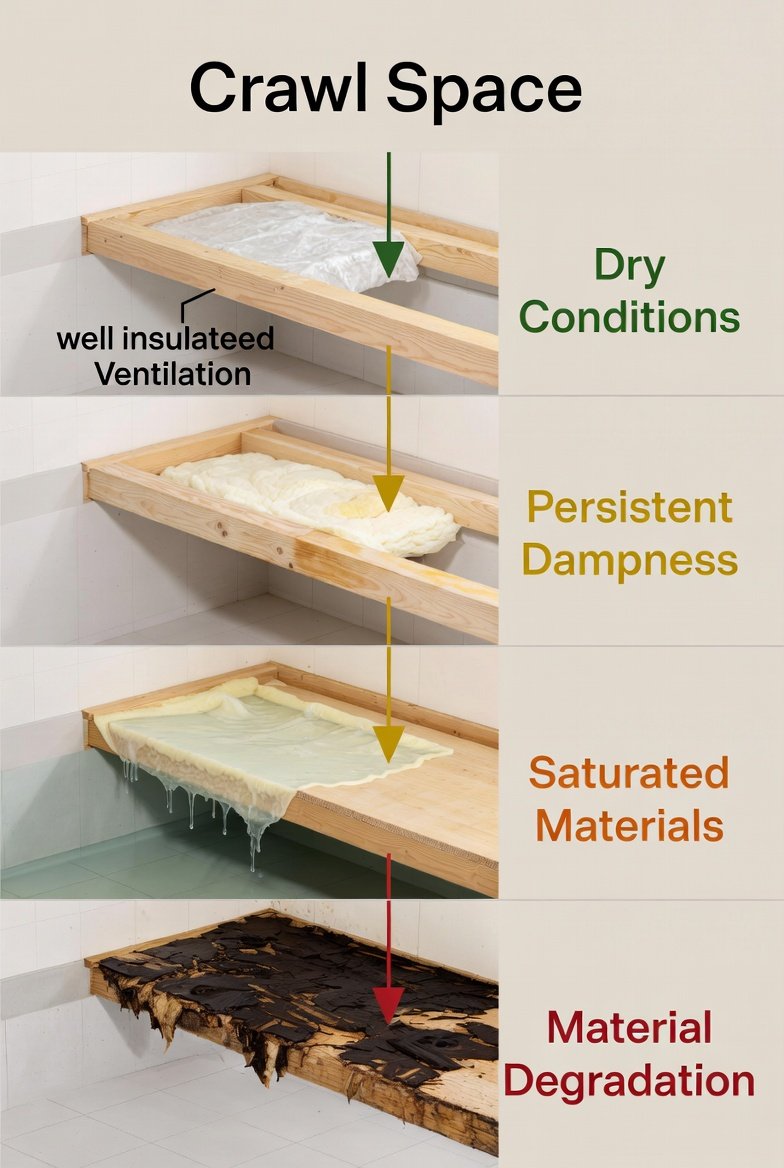
The Damage Progression Ladder (How It Actually Evolves)
Most SERP pages list risks. The useful truth is the sequence.
Stage 1 — Performance Damage (before “real damage” looks obvious)
This is when the crawl space environment starts reducing how the home performs.
What changes first
- insulation loses effectiveness
- floors feel colder
- humidity rises
- odors begin to appear intermittently
Fiberglass insulation can sag and compress when it repeatedly absorbs moisture, even without standing water. That “quiet failure” is why comfort symptoms often show up before structural symptoms.
Why this stage matters
It’s the early warning stage that many homeowners ignore because nothing looks broken yet.
Stage 2 — Material Deterioration (the “point of no return” begins forming)
This is where moisture stops being temporary and starts causing physical changes.
Subfloor deterioration (common and underestimated)
Plywood/OSB subfloors are especially vulnerable to repeated dampness:
- edges swell
- layers can separate
- fastener grip weakens
- the floor may feel “soft” in spots
Subfloors rarely collapse suddenly. The damage shows as noise, bounce, unevenness, or persistent “spongy” zones.
Wood moisture thresholds (why time matters)
Wood decay organisms don’t need floods—they need sustained moisture. Many building references cite elevated wood moisture content (often around ~20% and above) as a risk zone for fungal activity and decay conditions.
More detailed references discuss wood decay becoming notable at higher moisture contents and that some decay can continue at lower levels once established.
Translation for homeowners:
It’s not the single wet day. It’s the staying wet.
Stage 3 — Structural Concern (load path begins degrading)
Structural impact usually develops slowly and unevenly, which makes it easy to miss.
What “structural” means here
- joists, beams, sill areas, and support components losing integrity gradually
- fasteners corroding
- wood strength reducing over time
Engineering and building industry commentary consistently ties crawl space rot risk to prolonged moisture exposure and notes that rot can ultimately affect floor support conditions.
This stage often appears later in the living space as:
- sagging floors
- persistent bounce
- doors that begin to stick
- uneven transitions between rooms
Moisture Damage Without Flooding: The Most Common Scenario
Many homeowners assume: “No puddles = no damage.”
That assumption is why crawl space water after heavy rain damage is so often advanced before it’s noticed.
Persistent humidity alone can:
- keep wood elevated in moisture content
- keep insulation damp or compressed
- create favorable conditions for microbial growth
- Crawl space flooding
In other words: water damage can develop without a flood event, through repeated dampness and incomplete drying cycles.
Indoor Air Quality Effects: How Crawl Space Conditions Move Upstairs
Crawl spaces are not sealed voids. Air moves between the crawl space and the living area through:
- plumbing penetrations
- wiring holes
- subfloor gaps
- mechanical chases
When moisture persists, odors and microbial particles can migrate upward. Multiple indoor air quality discussions tie moisture control directly to mold prevention and indoor comfort.
Mold and microbial risk
The consistent message from building hygiene guidance is simple:
moisture is the driver; control moisture to control mold.
Even without visible “mold patches,” the conditions can still support microbial activity that shows up as:
- musty odors
- irritation for sensitive occupants
- persistent humidity feel indoors
(Important: this page is not diagnosing health outcomes—just explaining the pathway.)
Electrical and Mechanical Consequences (Slow Degradation, Not Instant Failure)
Crawl spaces often contain:
- wiring
- junctions
- HVAC runs
- plumbing lines
Persistent moisture exposure can accelerate:
- corrosion
- connector reliability issues
- insulation brittleness over long periods
This isn’t a guaranteed immediate hazard in every case, but it reduces safety margins gradually—exactly the kind of risk homeowners underestimate because nothing “sparks” today.
Pest and Biological Impacts (Why Damp Crawl Spaces Attract More Than Mold)
Moisture changes habitat.
Insects
Higher wood moisture and damp soil conditions can increase the likelihood of pests that prefer damp environments. Many crawl space moisture discussions explicitly tie dampness to increased pest pressure.
Rodents
Damp crawl spaces often lead to:
- compromised insulation (nesting material)
- odors and contamination
- amplified cleanup complexity later
Again: not every crawl space gets pests—but persistent dampness increases the probability.
Soil and Foundation Interaction (The Under-Discussed Consequence)
A crawl space is connected to soil behavior around and under the structure.
When soil stays saturated:
- crawl space humidity remains elevated
- fine particles can shift
- support areas may experience subtle movement stress over time
Concrete and masonry can also show signs of prolonged moisture exposure (efflorescence, surface changes). Those are often not “structural failure,” but they’re evidence of ongoing moisture interaction that tends to correlate with broader crawl space deterioration patterns.
The Key Boundaries (Fast Clarity Box)
Moisture → Damage
When materials stay wet long enough that drying cycles don’t complete (the 24–48 hour boundary is a widely used prevention benchmark).
Damage → Structural Concern
When load-bearing components show ongoing elevated moisture conditions and deterioration signs (soft wood, sagging, persistent damp framing, repeating wet cycles).
Crawl Space Environment → Indoor Impact
When crawl space air begins influencing the living space via odor, humidity, or microbial pathways.
Why Crawl Space Water Damage Is Cumulative (The “Moisture Debt” Effect)
The most misunderstood reality is accumulation.
Each wet cycle may look minor. Each drying period may look “good enough.”
But if the space never fully resets to dry conditions, moisture debt builds.
That is how homes end up with significant crawl space water damage even when:
- there was no memorable flood
- water is not visible on every inspection
- symptoms appear “randomly” upstairs
It wasn’t random. It was compounding.
When Observation Alone Stops Being Reliable
Some damage stays stable for a long time. Other damage progresses quietly until indoor symptoms show up.
If you’ve reached any of these:
- persistent odor that doesn’t clear
- ongoing humidity upstairs
- soft or uneven floors
- insulation consistently damp/sagging
…then a single crawl space glance often isn’t enough to understand whether the condition is temporary exposure or ongoing material degradation. A neutral inspection can clarify the status without forcing a repair decision.
Final Perspective
Crawl space water damage is rarely about one event. It is about behavior over time.
The consequences usually arrive in this order:
- performance impacts (comfort, insulation, humidity)
- material deterioration (subfloor, wood, fasteners)
- structural concern (load path degradation)
- indoor environment influence (odor/humidity/microbial pathways)
This page exists to make those consequences visible—so the crawl space stops being “out of sight, out of mind,” and becomes what it really is: part of the home’s long-term stability system.