
Crawl Space Waterproofing Is Less About Price — and More About Financial Confidence
When homeowners begin researching crawl space waterproofing cost, they are rarely just looking for a number.
They are trying to answer a deeper question:
“If I get quotes, how do I know what’s reasonable?”
The confusion is understandable. One contractor might suggest a solution near $4,000, while another proposes a system exceeding $15,000. Both can be legitimate — yet without context, the difference feels alarming.
Waterproofing is not priced like a simple repair. It is typically designed as a long-term water management strategy, and pricing reflects durability, scope, and risk tolerance as much as labor or materials.
Understanding how those variables shape cost allows homeowners to evaluate proposals with far greater confidence.
Typical Crawl Space Waterproofing Cost
Standing water in crawl space cost to fix
Most projects fall within:
👉 $3,000 to $12,000
Large or complex systems can exceed:
👉 $15,000 – $20,000+
The spread exists because waterproofing is not a single service. It ranges from targeted water control improvements to comprehensive systems designed to manage groundwater indefinitely.
The real question is not “What does waterproofing cost?”
It is:
“What level of protection is being priced?”
Why Two Legitimate Quotes Can Be Thousands Apart
One of the most misunderstood aspects of waterproofing is quote variation.
Price differences often reflect strategy, not inconsistency.
For example:
- A smaller quote may focus on correcting the most visible entry point.
- A larger quote may aim to prevent future intrusion entirely.
- Crawl space flooding
Both approaches can be technically sound — they simply assume different futures for the home.
Understanding that distinction prevents homeowners from comparing numbers without comparing intent.
Waterproofing as a Financial Decision — Not Just a Structural One
Unlike cosmetic upgrades, waterproofing rarely increases a home’s visible appeal. Its value lies in risk reduction.
From a financial perspective, homeowners are often weighing two paths:
Lower upfront cost with potential future work
vs
Higher upfront investment designed to reduce recurrence
Neither is universally correct. The right choice depends on how long you plan to own the property, the severity of water behavior, and your tolerance for uncertainty.
Thinking in those terms turns waterproofing from a reactive expense into a deliberate investment.
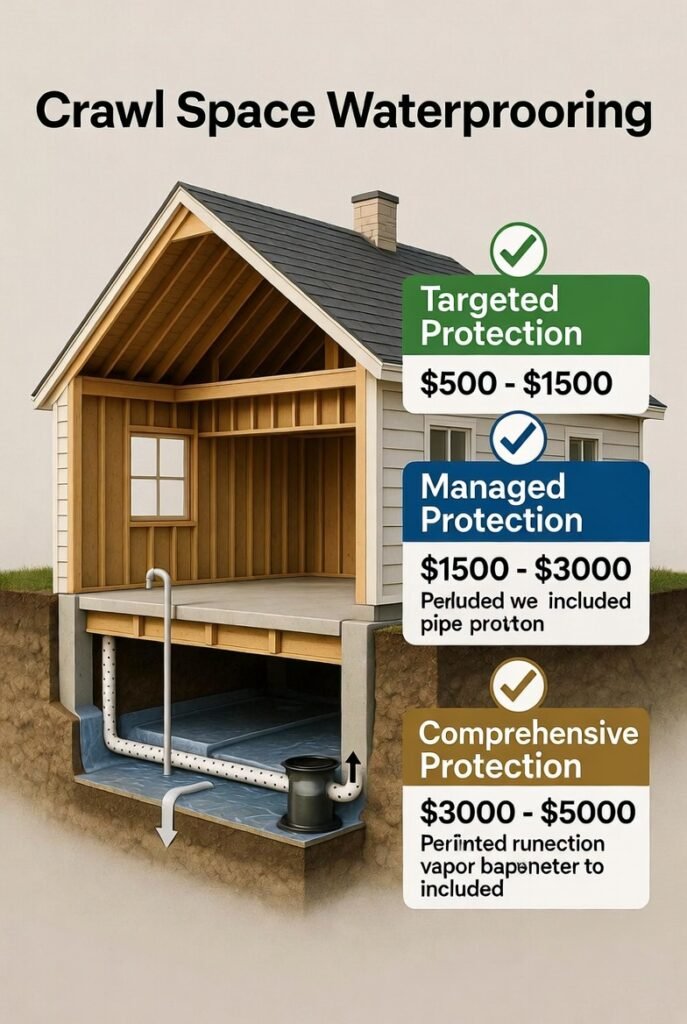
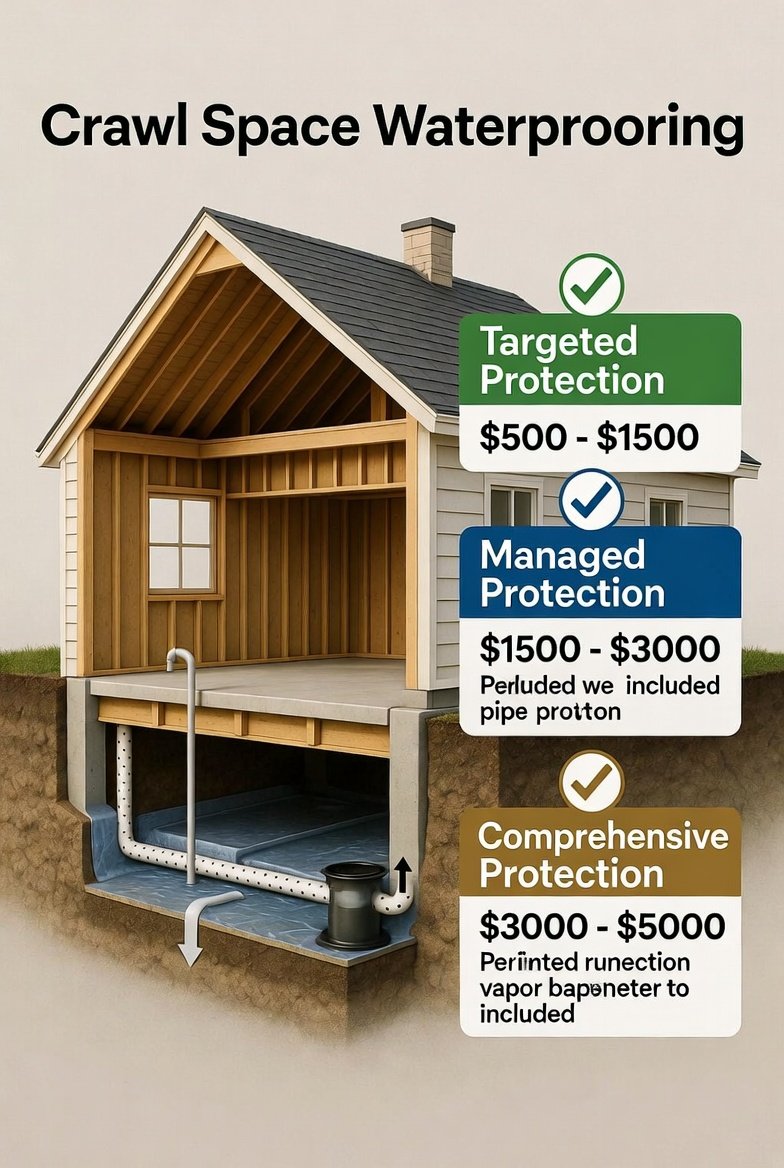
Cost Ranges by System Scope
Targeted Water Control
Typical Range: $3,000 – $5,500
Often appropriate when intrusion is limited and predictable.
Projects usually focus on controlling specific water paths rather than managing the entire water in crawl space environment.
This is often the entry point for waterproofing budgets.
Managed Water Systems
Typical Range: $5,500 – $9,000
Designed for recurring moisture rather than occasional intrusion.
These projects aim to stabilize conditions over time, reducing the likelihood of repeated repairs.
Homeowners frequently choose this level when early warning signs appear but structural materials remain intact.
Comprehensive Waterproofing Systems
Typical Range: $9,000 – $15,000+
Typically recommended when water behavior is persistent or difficult to predict.
Here, pricing reflects long-term control rather than short-term correction.
The goal shifts from reacting to water toward actively managing it.
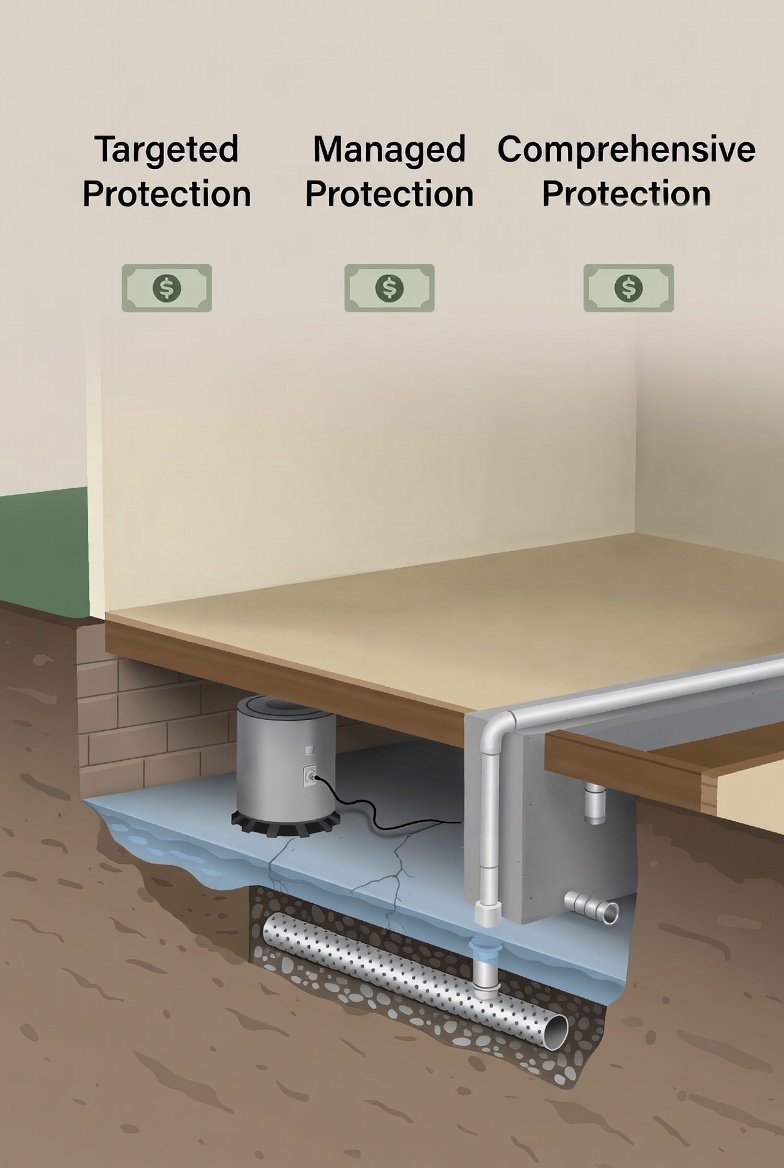
📊 Crawl Space Waterproofing — Cost Perspective
Protection Level | Typical Objective | Estimated Cost |
Targeted | Correct specific intrusion | $3,000 – $5,500 |
Managed | Stabilize recurring moisture | $5,500 – $9,000 |
Comprehensive | Long-term groundwater control | $9,000 – $15,000+ |
Regional labor rates and crawl space size influence totals.
The Lifespan Equation Most Buyers Overlook
A lower quote is not automatically cheaper.
If a modest repair must be repeated every few years, its long-term cost can surpass that of a durable system installed once.
Viewed through that lens, waterproofing becomes less about price and more about cost per year of protection.
Durability often reshapes what “expensive” actually means.
What Drives Waterproofing Costs Higher
Several variables quietly influence pricing:
Water Behavior
Frequent intrusion requires more robust control.
Crawl Space Size
More square footage increases materials and labor.
Accessibility
Tight spaces extend project timelines.
Existing Damage
Materials must often be stabilized before waterproofing begins.
These factors explain why neighbors sometimes receive dramatically different quotes.
Homes may look similar above ground while behaving very differently below it.
When Waterproofing Moves From Optional to Strategic
Water in crawl space after heavy rain
Many homeowners wrestle with timing.
Waterproofing tends to feel discretionary — until water patterns become predictable.
Repeated moisture often signals that passive defenses are no longer sufficient.
At that point, waterproofing becomes less about convenience and more about protecting structural reliability.
Early action frequently preserves flexibility.
Delayed action often narrows it.
Evaluating Quotes With Greater Confidence
When reviewing proposals, clarity matters more than the number itself.
Helpful questions include:
- What future condition is this system designed for?
- Is the goal correction or prevention?
- How does this approach handle recurring water?
These conversations often reveal why pricing differs — and which strategy aligns best with your expectations.
Insurance Expectations — Worth Verifying Early
Coverage for crawl space waterproofing varies widely and often depends on the cause of water intrusion.
Gradual groundwater issues are frequently treated differently than sudden plumbing failures.
Because policies differ, confirming details directly with your insurer is usually more reliable than assuming eligibility.
Planning financially without relying on uncertain reimbursement tends to reduce stress later.
Buyer and Inspection Perspective
Persistent moisture beneath a home can influence buyer perception even when manageable.
Waterproofing is often viewed as a stabilizing measure — one that signals proactive maintenance rather than deferred care.
For homeowners considering future resale, addressing water behavior early can help prevent negotiation friction later.
Budget Planning That Supports Better Decisions
When preparing financially, it helps to separate two concepts:
water control investment
and
damage repair
Waterproofing aims to prevent the second category from expanding.
Approaching the project with that framework often leads to clearer budgeting decisions.
What This Page Intentionally Does Not Decide
This guide focuses strictly on cost behavior.
It does not determine:
- whether waterproofing is necessary
- which system is appropriate
- how a contractor should design the solution
Those decisions depend on site-specific conditions and professional evaluation.
Key Cost Insight
Crawl space waterproofing cost is shaped less by a single moment of moisture and more by the long-term behavior of water beneath the home.
The clearer that behavior becomes, the easier it is to choose a protection level with confidence rather than urgency.
Final Perspective
For many homeowners, waterproofing is not simply a repair — it is a financial decision about how much uncertainty they are willing to accept beneath their home.
Understanding pricing structures transforms the process from confusing to manageable, allowing decisions to be guided by strategy rather than surprise.
❓ FAQs
How much does crawl space waterproofing usually cost?
Most projects range from $3,000 to $12,000, though comprehensive systems can exceed that range.
Why do contractor quotes vary so much?
Differences usually reflect strategy — whether the system focuses on correction or long-term prevention.
Is waterproofing cheaper when done early?
Early installation often prevents larger structural repairs, making it financially advantageous in many cases.
Does crawl space size affect cost?
Yes. Larger or difficult-to-access spaces typically require more labor and materials.