
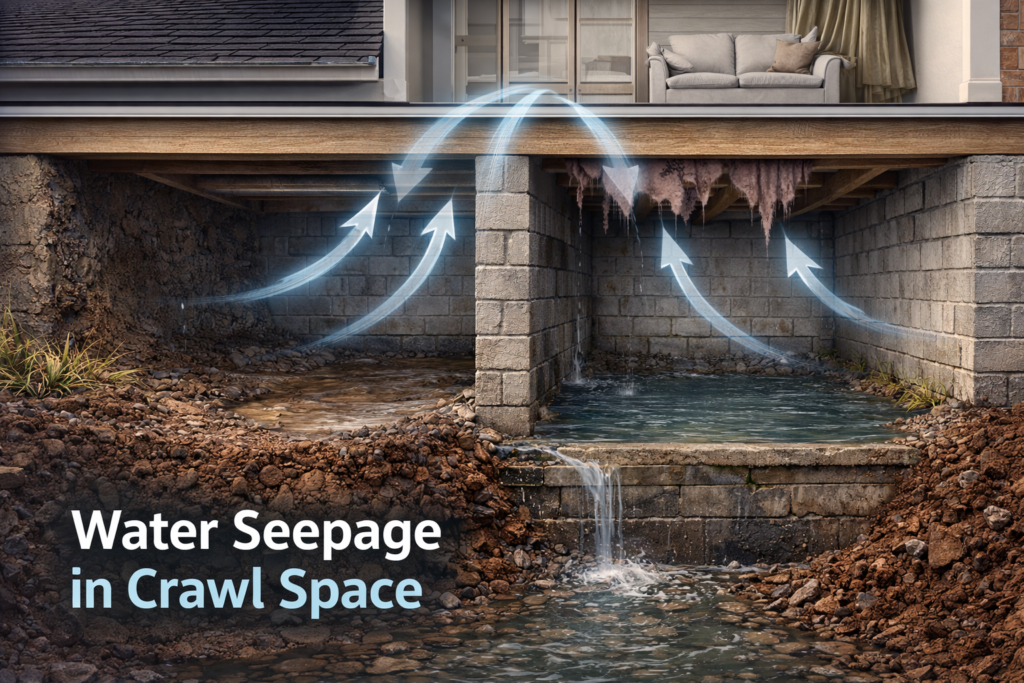
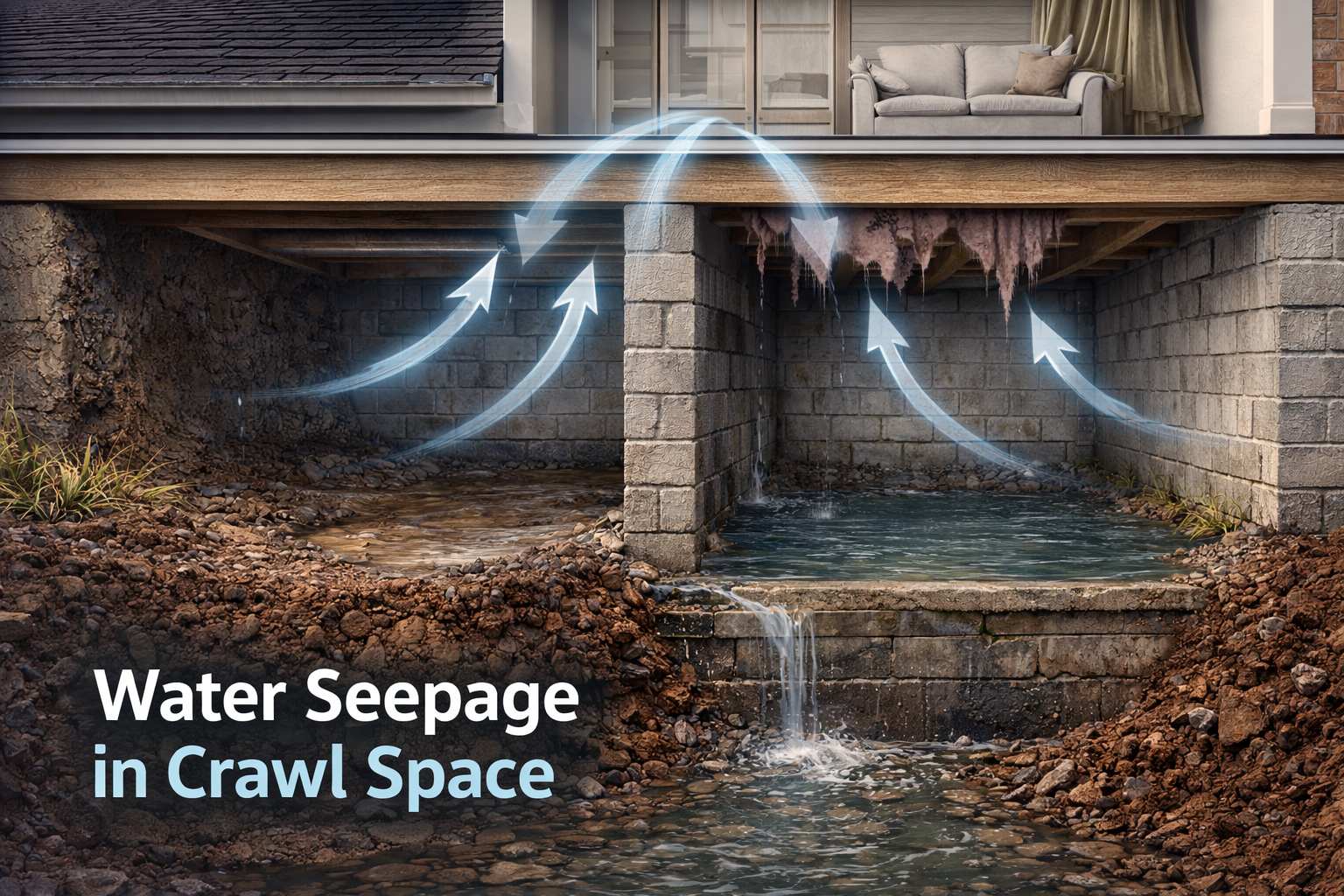
Water Seepage in Crawl Space: Why It Happens Beneath the Home
Water seepage in a crawl space is rarely dramatic. There’s usually no rushing water and no single “break.” Instead, seepage is what happens when wet soil and groundwater pressure keep interacting with foundation materials that are strong—but not waterproof.
That’s the core misunderstanding: most people look for a pathway (a crack, a hole, a leak). Seepage is often pressure-driven moisture migration, and it can occur even when the crawl space never “floods.”
This page explains the mechanism—soil moisture, groundwater behavior, pressure cycles, and material permeability—so seepage stops feeling random. It does not recommend drains, encapsulation, or repair systems.
What “Water Seepage” in a Crawl Space Actually Means
Seepage is not flooding.
- Flooding is water entering in volume and pooling due to flow (often surface-driven).
- Seepage is slow moisture movement through soil and porous materials, often appearing as:
- darkened masonry
- damp soil in repeating zones
- wet patches that return after rain
- moisture at joints and transitions
Think of seepage as water doing what it naturally does: moving from higher pressure and higher moisture concentration toward lower resistance.
Homeowners often ask is water in crawl space normal, but seepage reflects a different moisture mechanism.
The Soil Under Your Home Is a Water System, Not “Ground”
A crawl space sits above soil that behaves like a sponge and a network at the same time.
Soil holds and moves water through three main forces:
1) Storage (retention)
Soil retains water between particles. Finer soils (especially clay) retain more and drain slower.
2) Capillary movement
Water can move upward and sideways through small pore spaces, not just down.
3) Pressure (when saturated)
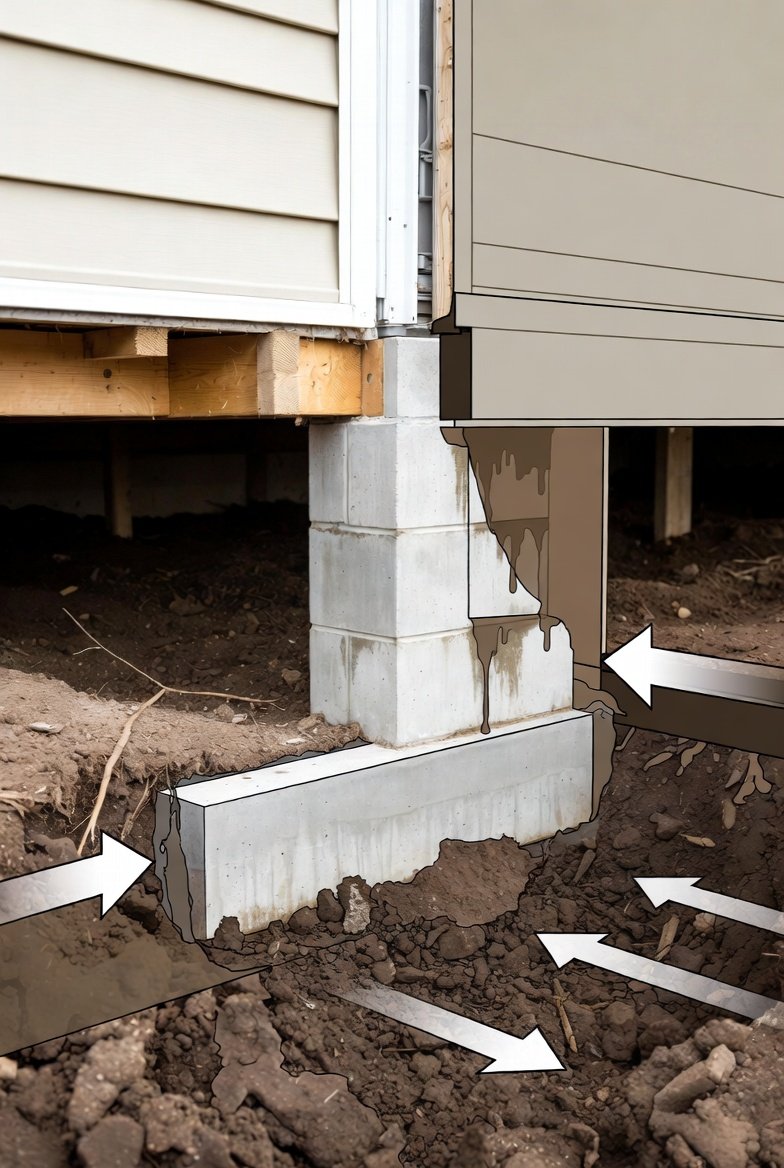
When soil becomes saturated, water generates force against foundation surfaces. That force is a key driver of seepage and is commonly described as hydrostatic pressure in foundation moisture contexts.
Mini takeaway: seepage begins in the soil, not in the crawl space.
Why Seepage Is Pressure-Driven (Not Just “Water Finding a Crack”)
When rainfall is heavy, prolonged, or repeated, soil around a foundation can reach saturation. Saturated soil doesn’t just “hold water”—it can press it against walls, footings, and slabs.
This is why seepage often shows up:
- along the lower portion of foundation walls
- at interfaces like wall-to-footing areas
- around penetrations where resistance changes
Hydrostatic pressure is a standard explanation used in building moisture discussions for why water can be pushed into foundations during wet periods.
Why Seepage Often Appears After the Storm (The Lag Effect)
A common homeowner confusion is timing:
“It rained yesterday, but the seepage showed up today.”
That pattern makes sense under a pressure model.
This lag effect explains why water in crawl space after heavy rain may appear hours or days later.
During the storm
- soil is absorbing water
- the water table or subsurface saturation is rising
- pressure is building gradually
After the storm
- the ground remains wet
- water redistributes laterally
- pressure continues pushing moisture toward the foundation
- the crawl space shows seepage as dampness or dark patches
So seepage can be delayed not because the storm caused “late water,” but because the soil reached its pressure threshold later.
Why Crawl Spaces Are Especially Vulnerable to Seepage
Crawl spaces tend to be vulnerable for structural and environmental reasons:
- They sit close to grade and soil moisture sources
- They often have limited airflow, slowing drying
- Their surfaces can be cool, increasing condensation risk
- They frequently include many interfaces (piers, seams, penetrations)
In plain terms: crawl spaces are positioned at the lowest-resistance part of the home’s below-grade environment.
Seepage Through Foundation Materials: Strong ≠ Waterproof
Many homeowners assume concrete “blocks water.” It doesn’t—at least not completely.
Concrete and masonry are porous. Some foundation guidance explicitly describes concrete as porous and susceptible to moisture intrusion under hydrostatic pressure conditions.
That doesn’t mean a foundation is failing. It means seepage can occur through:
Capillary penetration (micro-pore movement)
Moisture can migrate through microscopic pores in concrete/masonry. Capillary action is a recognized moisture transport mechanism in porous materials.
Interface zones (where resistance changes)
Seepage commonly appears at:
- wall-to-footing joints
- mortar seams
- cold joints
- penetrations (pipes, supports)
These are natural “transition points.” Not because they’re always defective, but because they’re often slightly less uniform than a solid wall section.
The Role of Soil Type (Why Clay Feels “Relentless”)
Seepage severity often correlates with soil behavior more than storm size.
Clay-heavy and fine-grained soils tend to:
- drain slowly
- hold water longer
- remain saturated longer
- maintain pressure against the foundation longer
Many foundation moisture explanations highlight that clay retains water and can contribute to higher pressure conditions than sandy soils, which drain more freely.
Mini takeaway: in clay-heavy sites, seepage can be persistent even when rainfall isn’t extreme—because the soil stays wet.
Seepage vs Surface Water Entry (The Critical Distinction)
These two are often mixed, and that causes wrong conclusions.
Surface water entry tends to be:
- visible pathways
- gravity-driven
- faster onset
- sometimes tied to obvious runoff patterns
Foundation seepage tends to be:
- invisible movement
- pressure-driven
- gradual and recurring
- linked to saturation and seasonal groundwater behavior
If the crawl space gets damp without an obvious flow path—and especially if it appears after a lag—seepage is often the better explanation model.
How Persistent Seepage Changes the Crawl Space Environment (Even Without Pooling)
Small seepage amounts can still shift crawl space conditions over time.
1) Elevated soil moisture → elevated humidity
Damp soil releases moisture vapor continuously. That can raise the crawl space humidity baseline.
2) Damp surfaces → longer drying cycles
Masonry and soil don’t “dry quickly” in a crawl space environment. That creates repeated damp windows.
3) Incomplete drying → cumulative exposure
When drying doesn’t fully reset between wet periods, the crawl space begins living in a more humid state.
That matters because moisture control is widely emphasized in mold prevention guidance, and drying speed is a central boundary in building hygiene recommendations.
(This page isn’t diagnosing mold—just explaining why persistent moisture changes the environment.)
The Seepage Recurrence Pattern (Why It Keeps Coming Back)
Seepage is rarely a one-time event because the drivers recur:
- seasonal groundwater rise
- repeated rain cycles
- soil that stays wet after storms
- changing pressure at the foundation surface
That’s why homeowners often describe seepage like this:
“It’s not always wet… but it always returns in the same place.”
Under a soil/pressure model, that repetition is expected. The foundation is interacting with a recurring external condition (saturation), not a random interior leak.
What the Location of Seepage Often Suggests (Without Diagnosing)
You can learn a lot from where seepage appears—without jumping to a fix.
Along lower wall areas
Often consistent with soil saturation and pressure acting near footing levels.
At a wall-to-footing line or seam
Often consistent with interface behavior under pressure.
Near penetrations
Often consistent with localized resistance changes.
In the same low zone repeatedly
Often consistent with soil moisture collecting and pressing at predictable points.
This is not diagnosis—it’s a cause framework. It helps make seepage predictable instead of mysterious.
Key Seepage Boundaries (Quick Reference)
Soil Saturation → Pressure Formation
Wet soil presses against the foundation and joints.
Pressure → Moisture Migration
Moisture moves through pores and interfaces under sustained wet conditions.
Seepage → Environmental Shift
Repeated dampness can keep a crawl space in a higher humidity state, which building moisture guidance treats as a key risk condition.
When Observation Alone Becomes Unreliable
Seepage is slow and subsurface. A crawl space can look “fine” on a dry day while the soil outside is still setting up the next pressure cycle.
If seepage is recurring, lagged (showing up after storms), or localized to the same interfaces, a professional assessment can help determine whether the behavior is:
- temporary saturation response
- seasonal groundwater pressure
- persistent subsurface moisture interaction
This is not about rushing to a solution—it’s about understanding whether the driver is structural-environmental or incidental.
Final Perspective
Water seepage in a crawl space is best understood as a soil-and-pressure behavior, not a single “leak event.”
Flooding is about volume and flow. Seepage is about saturation + pressure + permeability—and that’s why it often repeats.
If you frame seepage correctly, the pattern becomes explainable:
- it may appear after rain (lag time)
- it may return seasonally (pressure cycles)
- it may show up at seams and interfaces (resistance changes)
- it may persist even without puddles (humidity + retained moisture)
This page exists to give that clarity—without turning cause-analysis into a repair pitch.