
Standing Water Is Not Just a Repair — It Is a Cost Trajectory
When water begins pooling beneath a home, the financial question is rarely limited to today’s repair bill. Standing water typically signals a developing condition — one that tends to grow more expensive the longer it remains unresolved.
Many homeowners assume crawl space repairs fall into a predictable price band. In reality, costs behave more like a slope than a flat number. Early correction is often manageable. Delayed action frequently shifts the scope from moisture control into structural restoration.
Understanding how that cost trajectory works is what allows homeowners to plan instead of react.
Typical Cost to Fix Standing Water in a Crawl Space
Most residential repairs fall within:
👉 $1,500 to $8,000
However, once structural materials become involved, totals can exceed:
👉 $10,000 to $15,000+
Why such a wide spread?
Because contractors are not pricing the water itself — they are pricing:
- exposure time
- material impact
- recurrence risk
- labor complexity
- crawl space flooding
Water is inexpensive to remove. Damage is not.
The Cost Escalation Curve Homeowners Rarely See
Standing water follows a surprisingly predictable financial pattern.
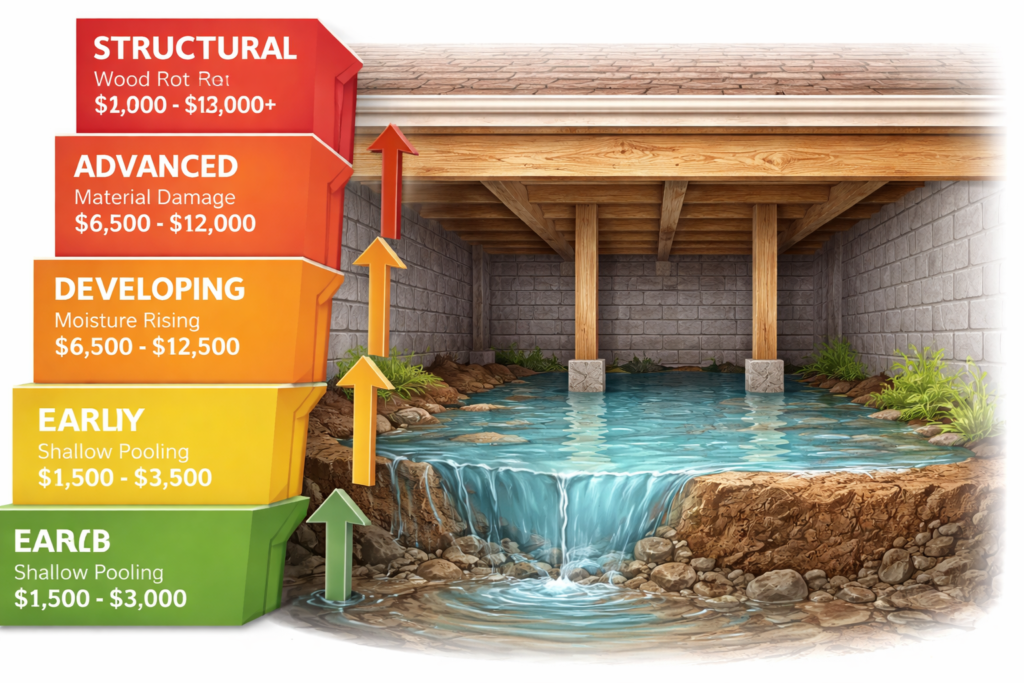
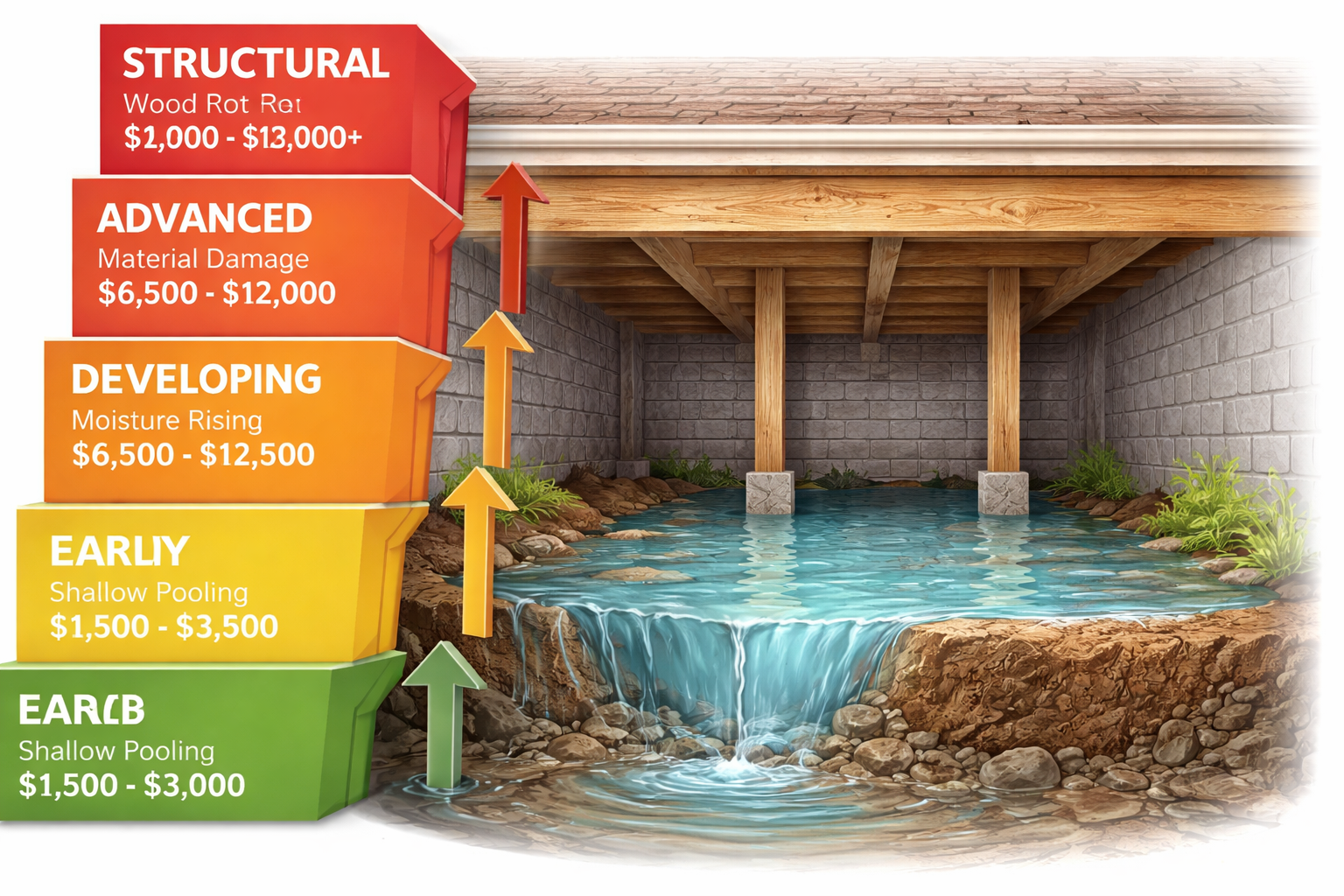
Early Stage — Contained Moisture
Estimated Range: $1,500 – $3,000
Typically involves correcting drainage paths or eliminating a single entry source.
At this stage, the crawl space is still structurally stable.
This is where repair costs are most controllable.
Developing Stage — Environmental Shift
Estimated Range: $3,000 – $6,500
Moisture begins altering the crawl space climate.
Common additions include:
- wet insulation removal
- targeted drying
- humidity stabilization
Labor increases because the environment must be restored — not just drained.
Advanced Stage — Material Impact
Estimated Range: $6,500 – $12,000
Here, water has moved beyond the floor surface.
It may now be affecting:
- joists
- subflooring
- support members
Repairs become less about prevention and more about preservation.
Structural Stage — Restoration Territory
Estimated Range: $12,000 – $20,000+
This is the financial tipping point many homeowners hope to avoid.
Once wood deterioration begins, repair conversations often shift toward partial reconstruction.
The project is no longer a moisture correction — it is a structural intervention.
📊 Financial Escalation Snapshot
Stage | Condition | Typical Cost |
Early | Shallow pooling, minimal exposure | $1,500 – $3,000 |
Developing | Persistent moisture | $3,000 – $6,500 |
Advanced | Structural contact | $6,500 – $12,000 |
Structural | Wood damage present | $12,000 – $20,000+ |
Regional labor rates and crawl space size can shift totals.
What Accelerates Crawl Space Repair Costs Most
Time Is the Primary Multiplier
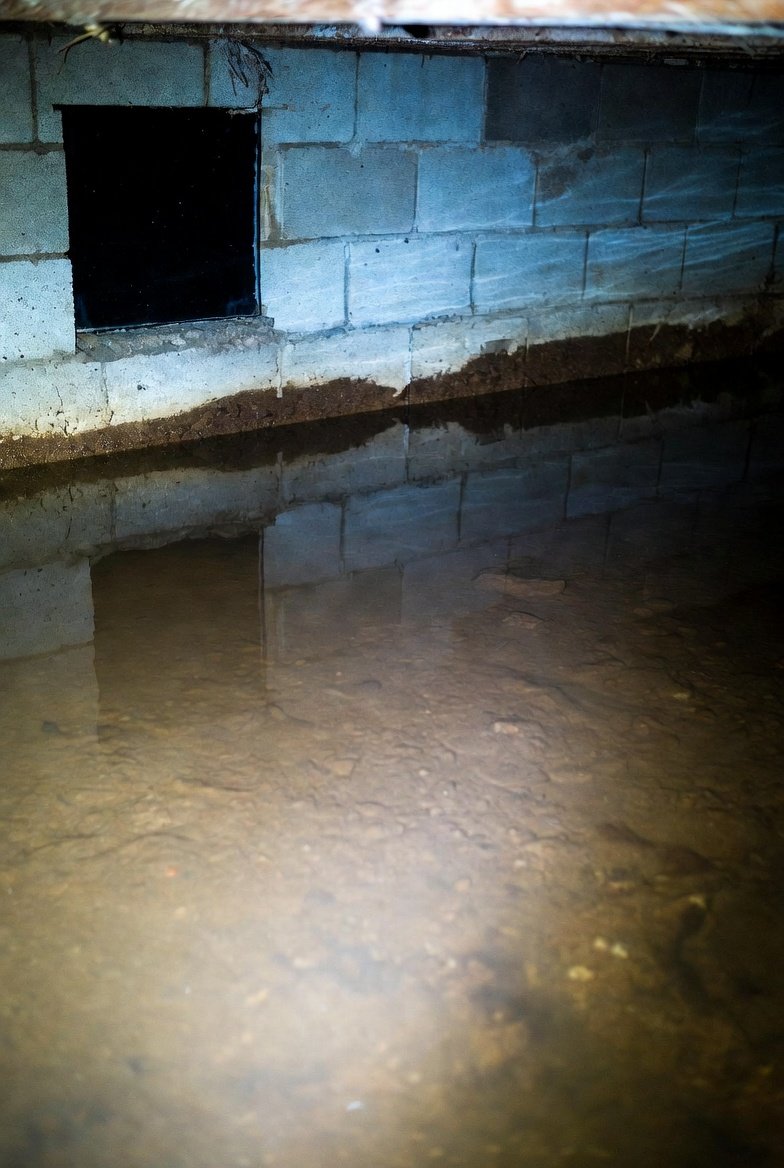
Water in crawl space after heavy rain
Water that drains quickly is rarely catastrophic.
Water that lingers quietly compounds risk.
Moisture exposure tends to behave exponentially — not gradually.
A delay of months can produce a dramatically different repair scope than a delay of weeks.
Recurrence Changes Contractor Strategy
A one-time event may require correction.
Repeated standing water forces professionals to think defensively.
Preventative measures often cost more upfront but reduce the probability of future repairs.
This is why estimates sometimes differ — contractors may be pricing different futures.
Size of the Affected Area
Localized pooling is financially manageable.
Widespread water coverage expands:
- drying time
- labor hours
- material replacement
The crawl space footprint directly influences the budget.
Accessibility Quietly Shapes Pricing
Tight clearances slow every phase of repair.
Restricted crawl spaces increase labor intensity — sometimes significantly — even when the fix itself is straightforward.
The Financial “Point of No Return”
There is usually a moment when moisture stops being a repair issue and becomes a restoration issue.
It often begins when wood moisture levels climb high enough to support decay.
At that point:
👉 drying alone is insufficient
👉 damaged sections may require replacement
Crossing this threshold tends to redefine the budget.
Recognizing it early preserves options.
The Cost of Waiting — A Simple Reality Model
Consider two scenarios.
Early Action:
Drainage correction and drying — several thousand dollars.
Delayed Action:
Material replacement, extended labor, environmental treatment — potentially five figures.
The difference is rarely subtle.
Standing water is one of the few home issues where hesitation reliably increases expense.
Why Repair Quotes Can Vary More Than Expected
Crawl space waterproofing cost
Homeowners sometimes assume price differences reflect inconsistency.
More often, they reflect differing philosophies.
One contractor may quote for immediate correction.
Another may design a system intended to reduce long-term recurrence.
Neither approach is automatically wrong — they simply model different risk horizons.
Understanding what future each quote assumes helps clarify the comparison.
Insurance Expectations — Often Misunderstood
Many homeowners wonder whether insurance offsets crawl space repairs.
Coverage typically depends on cause.
Sudden plumbing failures are sometimes treated differently than gradual groundwater intrusion.
Policies vary widely, making it wise to confirm details directly with the carrier rather than assume eligibility.
Planning financially without relying on uncertain coverage often leads to better decisions.
Inspection and Buyer Psychology
Standing water beneath a home rarely goes unnoticed during inspection.
Even when repairable, it can introduce hesitation into a transaction.
Common outcomes include:
- negotiated credits
- repair contingencies
- delayed closing timelines
Addressing the issue proactively helps maintain negotiating leverage if the property enters the market later.
Budget Planning That Reduces Financial Shock
When preparing for crawl space repair, it helps to think in layers:
Correction cost — stopping the water
Restoration cost — repairing what it affected
Who to call for water in crawl space
Separating these mentally creates a clearer budgeting framework.
It also prevents underestimating the total scope.
What This Page Intentionally Does Not Decide
Selecting a repair system requires diagnosis.
The correct approach depends on:
- moisture origin
- soil conditions
- structural layout
- recurrence risk
This guide focuses exclusively on cost behavior so homeowners can anticipate financial movement before committing to a solution.
A Financial Lens Moving Forward
Standing water is not just a maintenance issue — it is a developing liability.
Viewed early, it is often manageable.
Viewed late, it becomes expensive.
Most homeowners retain the greatest financial control at the beginning of that curve.
Key Takeaway
The cost to fix standing water in a crawl space is shaped far more by time and exposure than by the water itself.
Understanding how quickly repair costs can escalate allows homeowners to act strategically rather than react under pressure — protecting both the structure and the long-term budget.
❓ FAQs
How much does it cost to fix standing water in a crawl space?
Most repairs fall between $1,500 and $8,000, though structural cases can exceed $15,000.
Why do crawl space repair costs rise so quickly?
Extended moisture exposure can damage materials, increasing labor and restoration needs.
Does standing water always mean structural damage?
Not always, but prolonged exposure significantly raises the likelihood.
Is early repair financially smarter?
In most cases, correcting moisture early prevents far higher restoration costs later.