
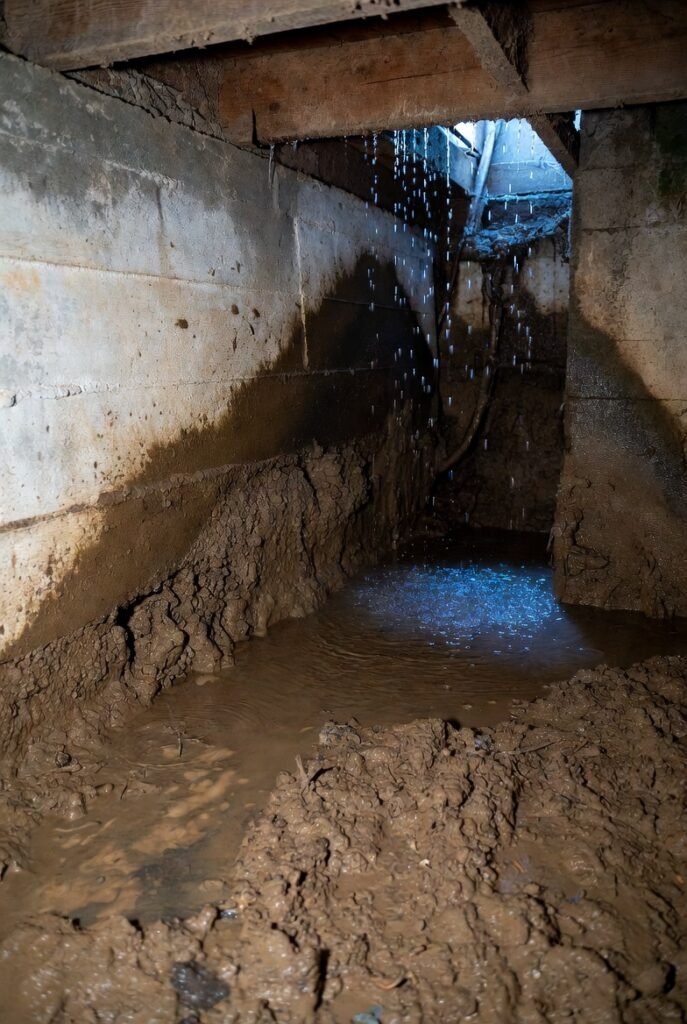
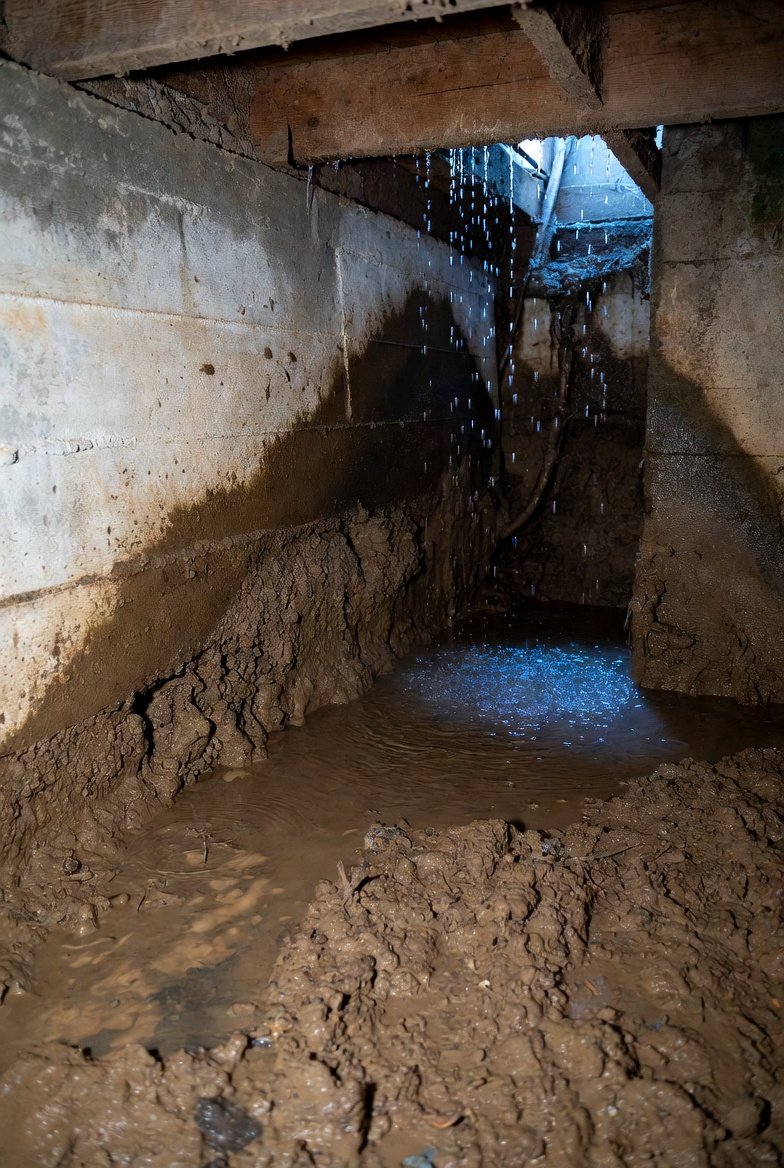
Waterproof Crawl Space: Why the Term Sounds Absolute — But Isn’t
The phrase “waterproof crawl space” carries a sense of certainty. It suggests a sealed environment beneath the home — protected, isolated, and unaffected by surrounding moisture.
Structurally, that certainty is misleading.
Not because crawl spaces cannot be improved… but because the idea of absolute waterproofing conflicts with how below-grade environments actually function.
This article clarifies what professionals typically mean when the term is used, why the language can create unrealistic expectations, and how crawl spaces truly interact with water over time. The goal is not semantic correction — it is structural understanding.
Why the Word “Waterproof” Feels So Convincing
In everyday language, waterproof implies permanence.
A waterproof watch survives immersion.
A waterproof jacket blocks rain entirely.
The expectation is simple:
water stays out — completely.
When applied to crawl spaces, that expectation travels with the word.
The problem is that homes are not sealed containers. They are environmental systems continuously interacting with soil, groundwater, and air.
What Waterproof Means in Technical Contexts
In structural and materials science, waterproofing refers to assemblies engineered to resist water penetration under defined pressure conditions.
Examples include:
- submerged structural membranes
- sealed containment structures
- pressure-tested barrier systems
These environments are designed for isolation.
Crawl spaces are not.
They operate within living soil — an environment that absorbs, releases, and redirects moisture continuously.
Authority perspective:
Isolation is engineered. Crawl spaces are integrated.
The Isolation Myth Beneath Homes
One of the most persistent misunderstandings is the belief that a crawl space can be separated entirely from surrounding moisture.
In reality, several conditions make complete separation unrealistic:
Soil Is Hydrologically Active
Soil expands when wet, contracts when dry, and transmits moisture through capillary movement.
Foundations Are Not Impermeable
Concrete allows slow vapor migration through microscopic pores — especially under sustained pressure.
Research consistently shows that moisture vapor can move through concrete slabs and walls, contributing to long-term dampness if not managed. United States Environmental Protection Agency
Air Exchange Never Fully Stops
Even conditioned crawl spaces experience some level of air movement through structural pathways.
Together, these factors prevent absolute isolation.
Why Professionals Rarely Use the Word Literally
In practice, when someone says a crawl space is “waterproof,” they are usually describing improvement — not immunity.
The phrase often signals that:
- visible water is controlled
- pooling is reduced
- moisture behavior is more predictable
These outcomes reflect management.
Not permanence.
Key recalibration:
A crawl space can be stabilized without being sealed from nature.
The Problem With Absolutes in Structural Language
Buildings operate within changing environments. Rainfall patterns shift. Groundwater rises and falls. Soil saturation varies seasonally.
Words like always, never, and completely rarely apply to structures interacting with natural systems.
When “waterproof” is interpreted as permanent protection, expectation drifts away from physical reality.
This is where misunderstanding begins.
Exposure vs Control — A More Accurate Framework
Understanding crawl space behavior becomes easier when separating two ideas:
Exposure — whether moisture can reach the space
Control — how that moisture behaves once it does
Most crawl spaces experience some level of exposure simply because of ground contact.
What differentiates one environment from another is control — the predictability of water movement and drying cycles.
Using “waterproof” blurs this distinction.
Environmental Equilibrium — What Stability Actually Looks Like
Rather than isolation, the structural goal beneath a home is equilibrium.
Environmental equilibrium means:
- moisture does not accumulate unpredictably
- drying cycles remain functional
- humidity stays within manageable ranges
This state is dynamic rather than fixed.
Conditions are guided — not frozen.
Structural insight:
Stability comes from balance, not from sealing a crawl space off from its surroundings.
Marketing Language vs Structural Reality
The popularity of the term is not accidental. It is simple, reassuring, and easy to understand.
But marketing language often favors clarity over precision.
Structural language favors accuracy.
When the two diverge, expectations can become misaligned — especially if homeowners assume conditions will never change again.
Recognizing this difference allows for more informed interpretation without dismissing legitimate improvements.
The Permanence Illusion
Perhaps the most subtle risk tied to the word “waterproof” is the idea that the crawl space no longer requires attention.
In reality, below-grade environments remain responsive to:
- seasonal rainfall
- shifting drainage patterns
- groundwater fluctuation
- soil saturation cycles
Improvement does not suspend environmental behavior.
It moderates it.
Terminology That Reflects Reality More Clearly
Professionals often prefer terms that describe behavior rather than absolutes, such as:
- water-managed crawl space
- moisture-controlled environment
- drainage-stabilized foundation space
These phrases acknowledge ongoing interaction while emphasizing predictability.
Precision does not complicate understanding — it improves it.
Why Language Matters More Than It Seems
Crawl spaces influence structural durability, indoor air conditions, and long-term material exposure. When terminology suggests total protection, it becomes harder to recognize subtle changes that deserve attention.
Clear language keeps observation aligned with reality.
And alignment supports better long-term awareness.
When the Term Becomes a Diagnostic Clue
Occasionally, describing a crawl space as “waterproof” can signal that language has replaced observation.
A more useful approach is to focus on behavior:
- Is moisture accumulating?
- Are conditions stable across seasons?
- Does water move predictably?
These questions reveal more than any label.
Final Clarification
A truly waterproof crawl space — in the literal sense — is not how below-grade residential structures function.
What exists instead are environments with varying degrees of exposure, control, and stability.
Understanding that distinction is not about correcting vocabulary.
It is about seeing the space beneath the home as it actually operates — connected to the environment, responsive to change, and dependent on balance rather than isolation.
Clarity replaces assumption.
And structural awareness replaces myth.