
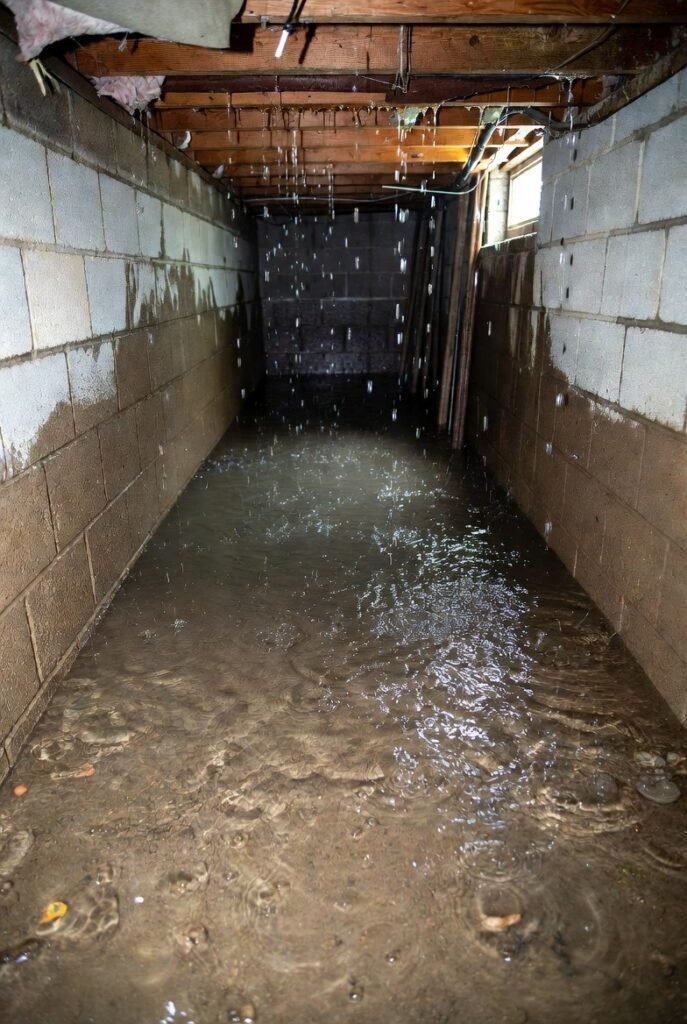
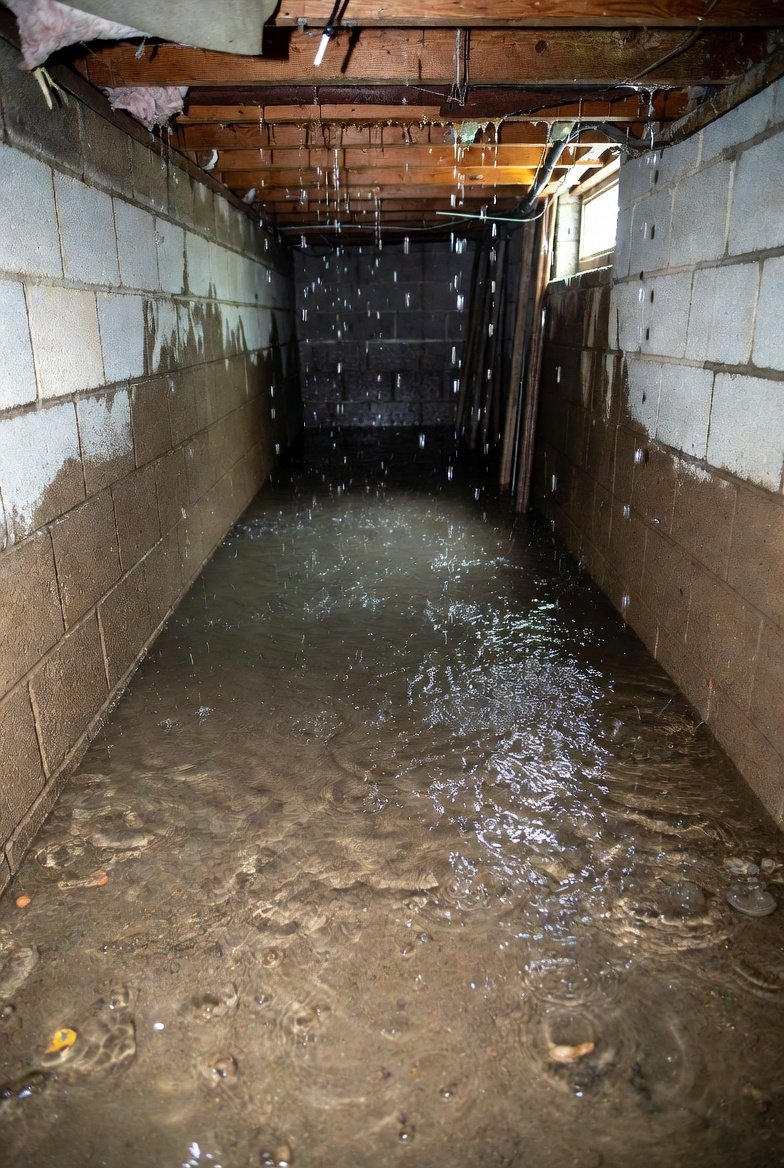
Crawl Space Flooding After Rain: The Hidden Water Sequence Beneath Your Home
Crawl space flooding after rain often feels backward. The storm has already passed, the sky has cleared, and surface puddles may even be disappearing — yet beneath the home, water suddenly appears.
This timing is not unusual. In fact, delayed flooding is one of the most predictable ways water behaves below grade.
Post-rain crawl space flooding rarely reflects the storm alone. It reflects a sequence — a chain of environmental reactions that begins in the soil and unfolds gradually beneath the structure.
Understanding that sequence transforms flooding from a surprise event into a readable signal.
Flooding Is Usually the Final Step — Not the First
Water does not move through the ground at the same speed it falls from the sky.
Rainfall is immediate.
Subsurface movement is progressive.
After rain begins, soil absorbs moisture layer by layer. As pore spaces fill, the ground transitions from absorption to displacement — meaning additional water must move somewhere else.
Crawl spaces frequently become that destination.
Micro-perspective:
Inspectors often describe post-rain flooding as “water arriving late,” not “water entering suddenly.”
The Hidden Water Sequence Beneath a Home
Most crawl space flooding after rain follows a consistent environmental progression:
Rainfall → Soil Saturation → Pressure Increase → Lateral Migration → Accumulation
Each stage depends on the one before it.
Flooding becomes visible only at the end — after multiple invisible shifts have already occurred.
This is why the timing feels disconnected from the weather.
Why Soil Rarely Releases Water Immediately
Many homeowners assume water drains downward quickly. In reality, saturated soil behaves more like a sponge than a filter.
Upper layers fill first.
Lower layers compress gradually.
Pressure builds quietly between them.
Once soil approaches saturation, new rainfall no longer infiltrates efficiently. Instead, it redirects sideways toward zones of lower resistance — often foundation edges or subsurface voids.
This redirection commonly continues long after rainfall stops.
Key insight:
Flooding after rain is frequently pressure-driven rather than gravity-driven.
The Subsurface Delay Effect
Delayed flooding is not a malfunction of the structure — it is a natural outcome of underground water physics.
Several forces contribute:
- capillary movement between soil particles
- hydrostatic pressure pushing toward foundations
- slow migration through dense or clay-heavy soils
Together, these forces create a lag between rainfall and water arrival.
The heavier the soil composition, the longer this delay can become.
Why the Crawl Space Often Becomes the Release Zone
Crawl spaces sit in a uniquely receptive position.
They are typically:
- close to surrounding soil
- near or slightly below exterior grade
- cooler than outdoor air
- slower to evaporate moisture
When subsurface pressure rises, water seeks relief. The crawl space frequently offers the path of least resistance.
This is less a failure than a function of physics.
The Threshold That Turns Moisture Into Flooding
Flooding typically begins when one critical boundary is crossed:
absorption capacity → exceeded
Before that point, soil buffers incoming moisture.
After that point, the environment shifts from containment to displacement.
Think of it as an underground tipping point.
Why Some Storms Cause Flooding — and Others Do Not
The difference often lies in baseline moisture, not rainfall totals.
A crawl space water starting from dry conditions can tolerate substantial precipitation.
A crawl space beginning from elevated moisture may flood after comparatively moderate rain.
From a structural perspective, flooding is less about storm size and more about starting position.
Mini insight:
Professionals often evaluate flood risk by asking, “How wet was the ground before the storm?”
Accumulation Events vs. Single Storm Events
Flooding after rain is frequently cumulative.
Back-to-back weather systems can quietly elevate subsurface moisture until the next rainfall pushes the environment beyond its limit.
In these cases, the final storm is remembered — but the earlier saturation is what enabled flooding.
This is why post-rain events often feel disproportionate to the weather itself.
Where Post-Rain Flooding Typically Appears
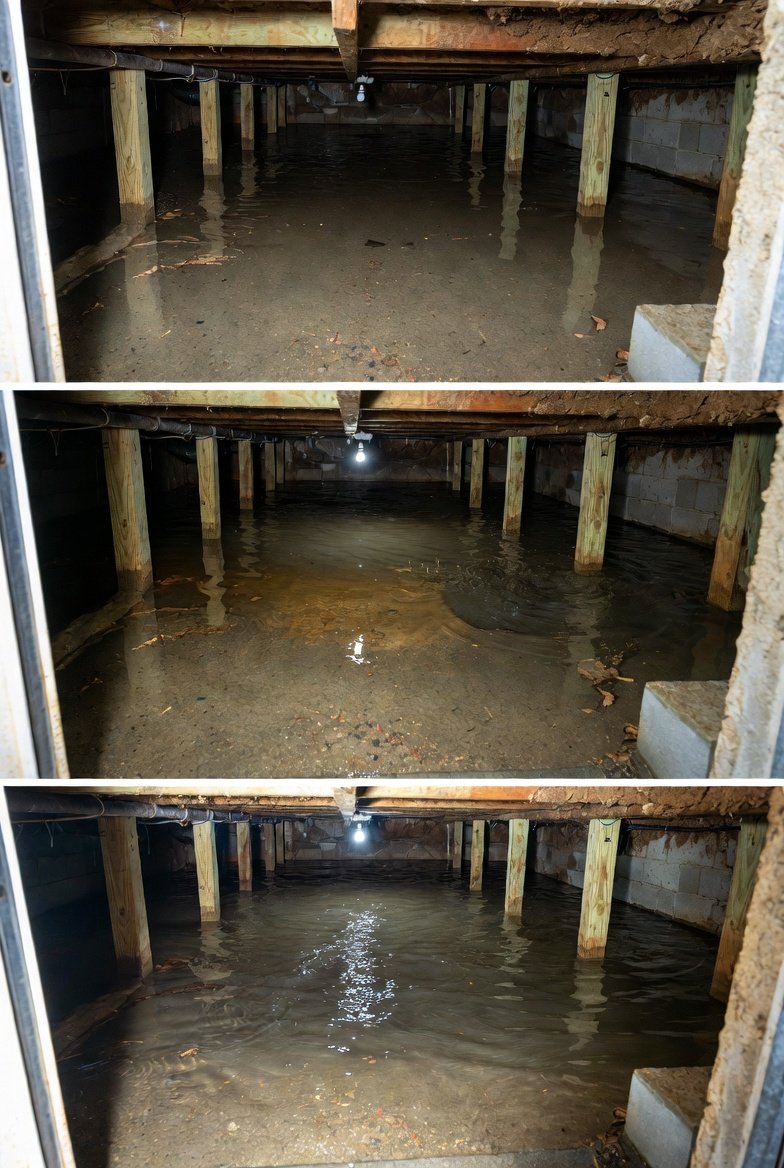
Water beneath a home follows both gravity and pressure gradients. Over time, it tends to settle in predictable areas.
Common accumulation zones include:
- low points beneath the crawl space water problems
- transitions near foundation walls
- locations with historical dampness
- areas where soil retains moisture longer
Once water selects these zones, recurrence becomes more likely.
Overlap is rarely random.
Early Signals That Often Precede Delayed Flooding
Visible water is rarely the first indicator.
Subtle environmental changes often appear beforehand:
- soil remaining dark between storms
- air feeling cooler or heavier
- faint odors emerging after rainfall
- damp zones expanding gradually
These signs suggest the subsurface environment is approaching its capacity threshold.
Flooding is often the confirmation — not the beginning.
Why Post-Rain Flooding Feels Unpredictable
From above ground, rainfall looks uniform. Beneath the surface, conditions are constantly shifting.
Variables include:
- seasonal groundwater elevation
- prior moisture cycles
- drying duration
- soil composition
Because these factors are hidden, the resulting flooding appears random even when it is environmentally consistent.
Surprise often reflects invisibility rather than unpredictability.
When Delayed Flooding Becomes a Pattern
One event may reflect unusual weather.
Repetition signals environmental behavior.
If flooding appears:
- after multiple rain events
- in similar locations
- with increasing persistence
the crawl space is likely responding to recurring subsurface pressure rather than isolated storms.
Patterns carry more diagnostic weight than single observations.
Why Waiting for Visible Water Misses the Real Signal
By the time flooding is visible, several underground transitions have already occurred:
soil saturation
pressure escalation
pathway formation
water migration
Flooding is the final expression of that chain.
Understanding the sequence shifts focus from reaction to interpretation.
When Surface Observation Has Limits
Because water movement underground is gradual and concealed, exterior conditions rarely tell the full story.
A neutral evaluation can help clarify:
- whether subsurface moisture is resetting
- whether pressure conditions are rising
- whether accumulation is becoming more probable
This is about environmental awareness — not urgency.
Final Perspective
Crawl space flooding after rain is seldom caused by rainfall alone. It is usually the visible outcome of a hidden environmental sequence unfolding beneath the structure.
Rain initiates the process.
Soil enables it.
Pressure directs it.
Accumulation reveals it.
When the sequence is understood, delayed flooding stops feeling mysterious — and begins to look structurally predictable.