
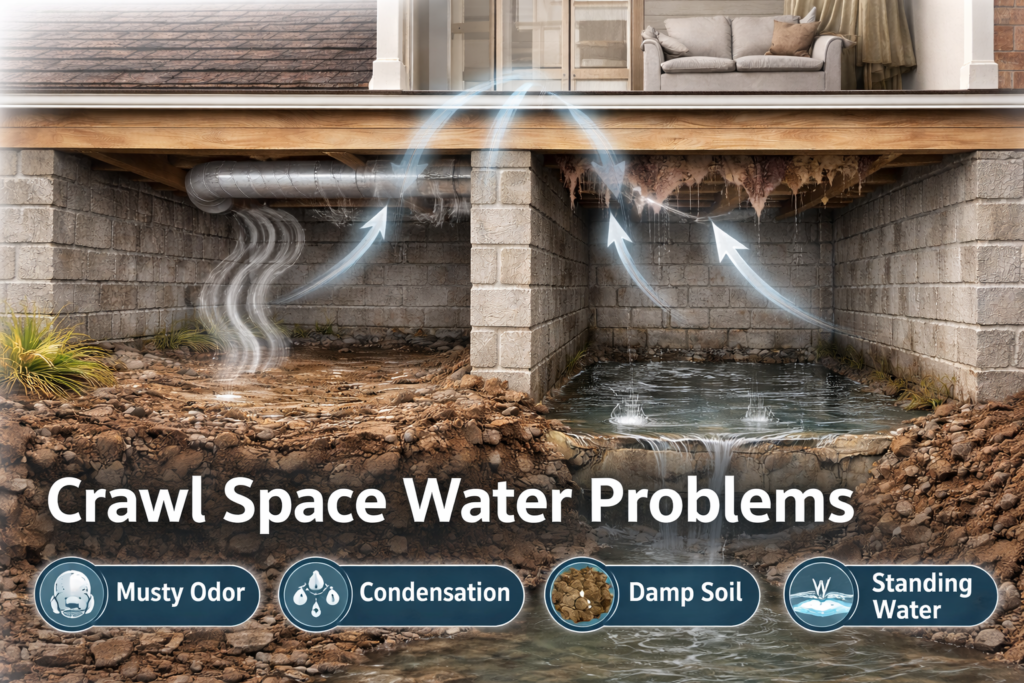
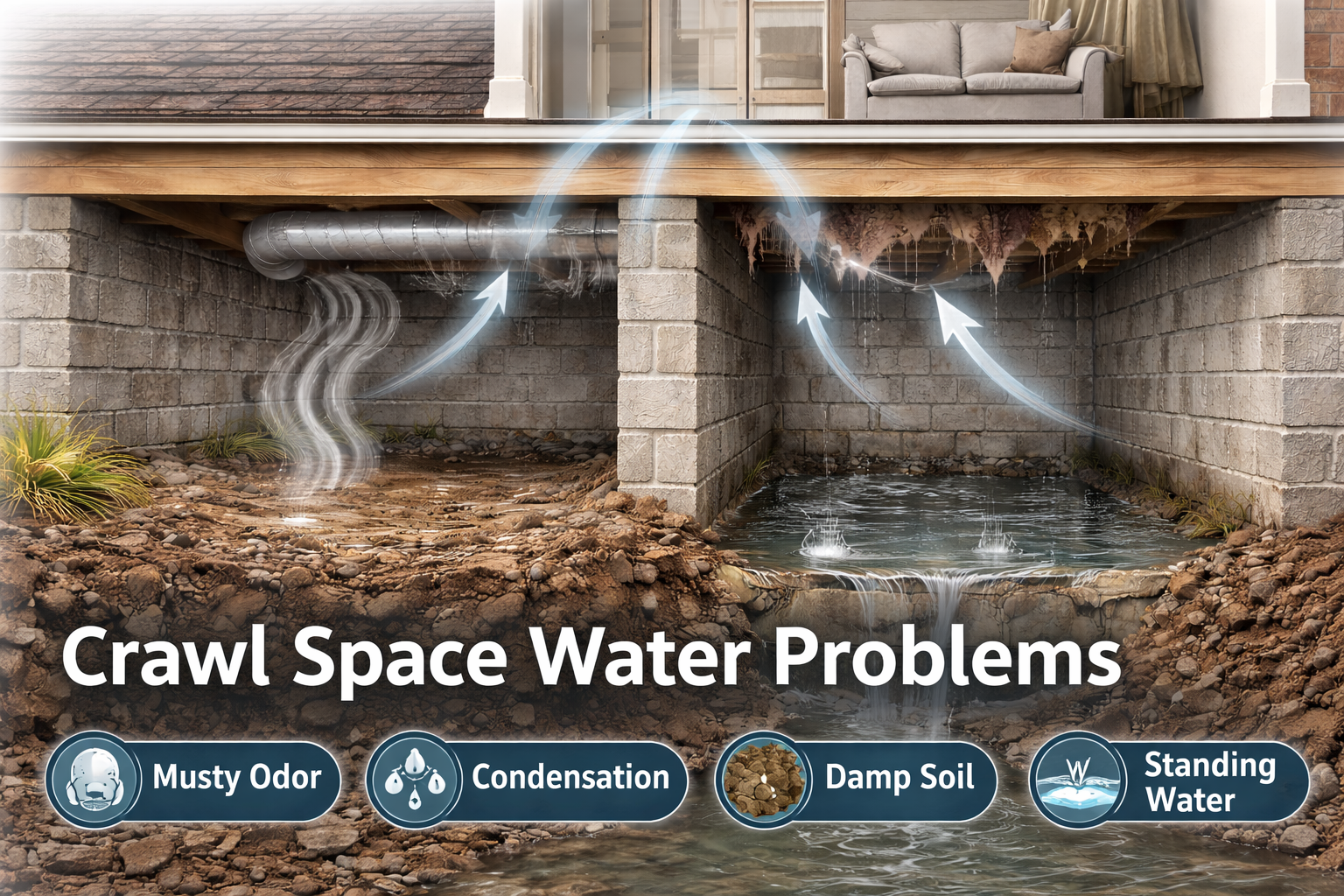
Crawl Space Water Problems: The Symptom Patterns Most Homes Show Before Damage Begins
Most crawl space water problems do not begin with obvious flooding or dramatic failure. They begin quietly — as small environmental shifts beneath the structure that are easy to dismiss when viewed in isolation.
A faint odor.
A colder floor.
Condensation that appears without explanation.
Individually, these signs rarely trigger concern. Together, they form a pattern — one that often signals ongoing water interaction below the home.
This article explains how crawl space water problems typically present, why symptoms tend to cluster, and what those groupings usually indicate. It focuses on recognition rather than correction, helping clarify how water beneath a structure communicates long before damage becomes visible.
Why Crawl Space Water Problems Are Rarely Obvious
Crawl spaces are hidden by design. Positioned between soil and structure, they operate as transitional environments where moisture behavior is influenced by groundwater, temperature shifts, and seasonal pressure changes.
Because the space is not regularly observed, water problems tend to surface indirectly through environmental changes rather than visible events.
Most homeowners notice:
- Smell before sight
- Comfort changes before structural symptoms
- Recurrence before severity
Understanding this sequence is critical.
Water problems are rarely defined by a single signal — they are defined by pattern formation.
The Diagnostic Principle: Patterns Matter More Than Individual Signs
One damp symptom can be incidental.
Multiple recurring symptoms rarely are.
Building science often evaluates crawl spaces by looking for environmental convergence — the point where independent indicators begin reinforcing the same underlying condition.
For example:
Musty odor + elevated humidity
almost always suggests persistent moisture.
Cold floors + insulation compression
often points toward prolonged dampness below.
The shift from coincidence to pattern is where crawl space water problems become meaningful.
Early Environmental Signals
The earliest indicators typically affect air quality before materials.
Musty or Earth-Like Odor
Persistent odor usually reflects moisture interacting with organic materials such as soil or wood.
Importantly, smell does not require standing water. Elevated humidity alone can sustain odor production.
Micro-perspective:
Inspectors often say the nose detects crawl space changes before the eye does.
Odor That Appears After Rain
When smells intensify following rainfall, it often indicates delayed vapor release rather than immediate water intrusion.
Soil retains moisture.
Evaporation releases it gradually.
This lag explains why crawl spaces sometimes smell worse days after a storm.
Visual Signals Beneath the Structure
Not all water problems are hidden — but most require intentional observation.
Persistently Dark Soil
Soil that never fully lightens between rain cycles often indicates incomplete drying.
Dry soil resets.
Chronically damp soil accumulates moisture debt.
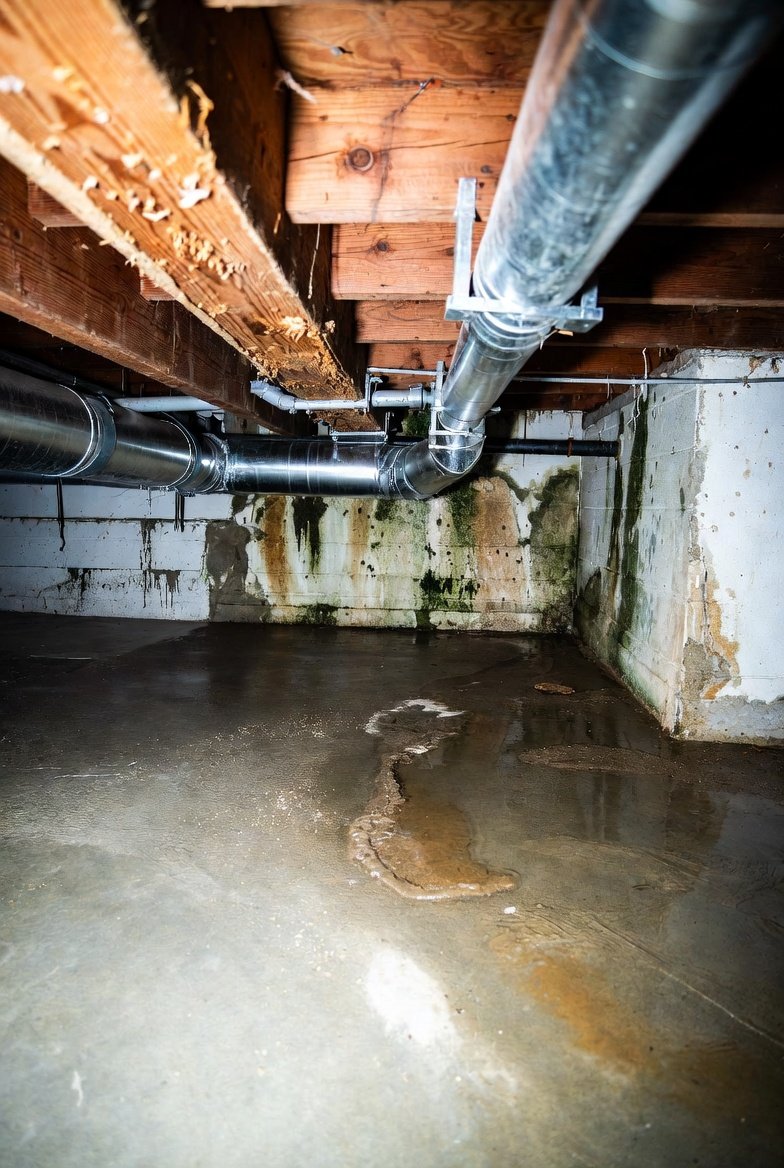
Water Staining or Tide Marks
Discoloration along piers or foundation walls typically reflects repeated contact at similar elevations.
Water may not be present now — but it has been there before.
Repetition matters more than timing.
Surface Condensation
Droplets forming on ducts, pipes, or framing often signal elevated humidity driven from below rather than leaks from above.
Condensation is frequently an environmental symptom, not a plumbing one.
Structural-Adjacent Symptoms
Water rarely attacks structures immediately. It first alters material behavior.
Soft or Slightly Uneven Floors
Subfloor materials respond gradually to moisture exposure.
Most homes do not experience sudden floor failure. Instead, subtle flexing develops over time.
Small changes deserve attention precisely because they are easy to normalize.
Increased Floor Noise
Wood movement changes as moisture content rises.
Creaking alone is not diagnostic — but when paired with humidity or odor, it becomes part of a larger signal cluster.
Indoor Comfort Clues That Often Go Misread
Many crawl space water problems reveal themselves through changes upstairs.
Cold Floors Despite Normal Heating
Moisture reduces insulation effectiveness. Even minor compression can alter thermal performance noticeably.
Homeowners often adjust thermostats without realizing the source lies below.
Elevated Indoor Humidity
Air does not respect floor boundaries.
Vapor migrates upward through framing cavities, plumbing penetrations, and subfloor seams.
What feels like a ventilation issue may actually be moisture influence from beneath the structure.
Heavy or Stagnant Indoor Air
Air that feels persistently dense often reflects increased vapor content rather than airflow failure.
This distinction matters — because the solution paths differ entirely.
Mechanical and Material Indicators
Systems housed seepage in crawl spaces often reveal long-term exposure first.
Corrosion on Metal Components
Rust is rarely caused by a single wet event. It typically reflects prolonged humidity.
Mechanical deterioration tends to mirror environmental conditions over time.
Insulation Deformation
When insulation loses shape or begins sagging, it usually signals repeated moisture interaction — even if no water is visible during inspection.
Performance declines long before materials fully fail.
The Escalation Ladder Most Homes Follow
Understanding progression helps distinguish nuisance from risk.
Stage | Typical Signal | What It Suggests |
Early | Odor, humidity | Elevated moisture presence |
Developing | Damp soil, condensation | Incomplete drying cycles |
Established | Material changes | Persistent environmental exposure |
Advanced | Floor shifts, recurring odor | Long-term moisture interaction |
Water problems rarely skip stages.
They accumulate.
Why Crawl Space Water Problems Are Frequently Underestimated
Gradual change is psychologically easy to dismiss.
When symptoms appear slowly:
Homeowners adapt.
Expectations recalibrate.
Concern fades.
Until multiple signals converge.
By the time patterns become obvious, conditions beneath the home have often been active for far longer than assumed.
Seasonal Recurrence: One of the Strongest Indicators
Timing often reveals more than severity.
Symptoms that appear:
- every spring
- after prolonged rain
- during snowmelt
typically reflect groundwater behavior rather than isolated events.
Temporary disappearance does not equal resolution.
It often reflects environmental cycling.
Symptom Clusters That Rarely Occur by Chance
Watch for combinations such as:
- Musty odor + dark soil
- Cold floors + duct condensation
- Seasonal smell + staining
- Indoor humidity + insulation sagging
When independent indicators align, standing water crawl space water problems become significantly more probable.
Overlap is the signal.
When Observation Alone Stops Being Reliable
Because crawl spaces are concealed environments, surface impressions can mislead.
What appears stable upstairs may not reflect conditions below.
A neutral inspection helps clarify:
- whether symptoms are linked
- whether patterns suggest recurrence
- whether environmental drift is occurring
This is about awareness — not urgency.
Final Perspective
Crawl space water problems rarely begin with visible water. They begin with environmental signals that strengthen as they repeat.
No single symptom defines a problem.
Patterns do.
Recognizing those patterns early helps align expectations with structural reality — long before minor environmental changes evolve into material consequences.